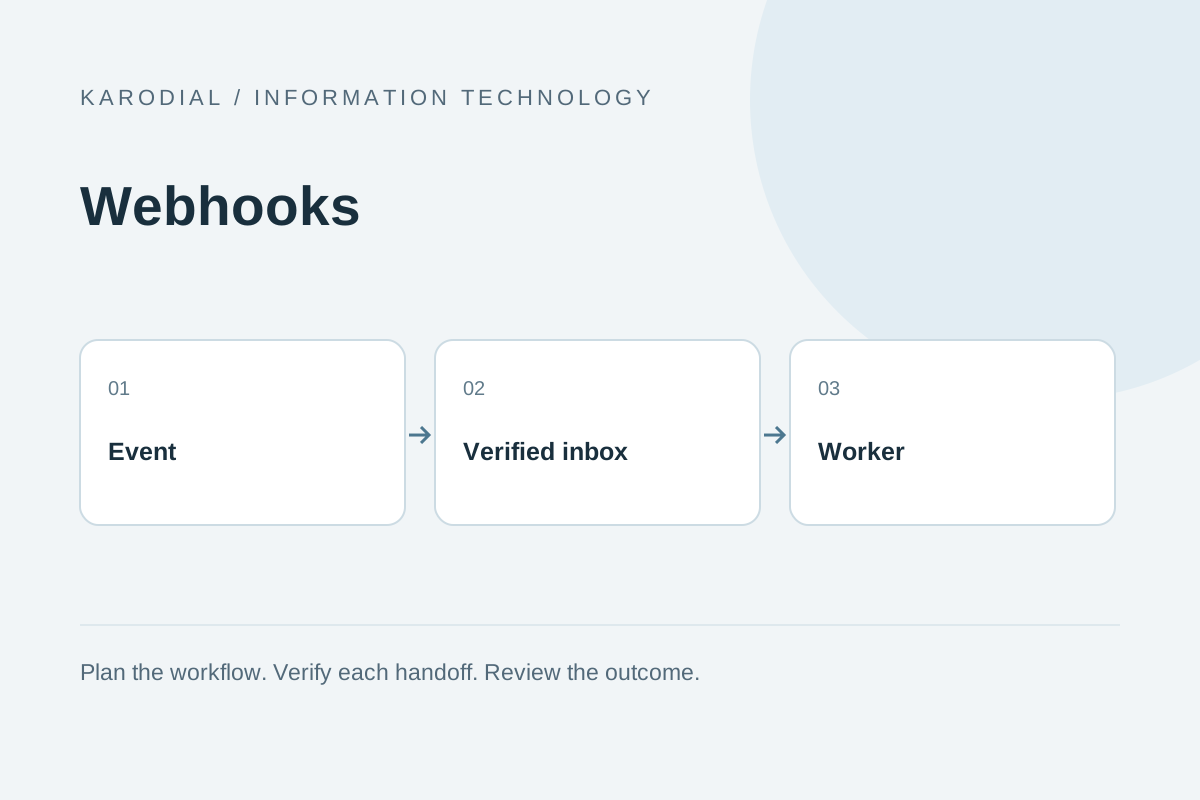
Your application asks a service to send a message. The service accepts the request, but the actual delivery happens later. How will your application learn the result? A webhook lets the service send an event to a URL you control. This pattern connects many business systems, from messaging to order processing. It can reduce repeated status checking and support timely automation. However, a webhook is only useful when incoming events are verified, stored and applied correctly. The important work happens after creating the callback URL.
Understand an event notification
A webhook is generally an HTTP request triggered by an event in another system. The request carries data describing what happened. Your application exposes an endpoint to receive it. The sending service may notify you about a new message, a changed record or a completed job. Exact formats, authentication and delivery behavior depend on the provider.
Compare this with repeatedly asking whether something has changed. With a webhook, the provider initiates the notification when it has an event to report. This does not mean every notification arrives immediately or exactly once. Network interruptions and provider retry policies still matter. Read the specific event contract, including what each status proves. A delivered notification and a customer actually reading a message may represent different states.
Choose events around a useful decision
Subscribe to events that drive a business action or supply necessary evidence. Receiving every possible event makes processing and monitoring harder. For a messaging workflow, you might need acceptance, delivery and failure information. For an enquiry, a CRM assignment event might notify the responsible employee. Each subscription should have an identified consumer and a clear purpose.
Write a small event map before implementation. Record the event name, its identifier, the affected object, the expected state change and the person responsible for exceptions. Include required fields and version assumptions. Avoid triggering a new external action from any incoming payload without checking its type and relation to an existing operation. A webhook should make the workflow clearer rather than create an invisible chain of automatic side effects.
Expose a focused receiving endpoint
Use a stable HTTPS endpoint designed for the provider's request format. Keep it separate from ordinary user forms and avoid putting secret credentials in the URL. Apply sensible request-size limits and validate the supported method and content type. Return the response expected by the provider, using the correct status code when a request cannot be accepted.
The endpoint should do a small amount of dependable work. Verify authenticity, validate the essential envelope and durably save the event or queue it. Slow reporting, media processing and outgoing notifications can happen in workers. Providers often impose a response deadline, but the exact deadline differs. Design around the published contract. Returning quickly is helpful only when the event has actually reached a recoverable state.
Verify authenticity before trusting the payload
Many providers sign webhook requests using a shared secret or another verification scheme. Follow the provider's documented method exactly. Verification may depend on the original body bytes, request URL, headers and timestamp. Parsing and re-encoding JSON before verification can change those bytes and cause failures. Test with valid signatures as well as altered payloads.
Keep webhook secrets in server configuration and rotate them through a controlled process. If timestamps or replay protection are supported, apply their documented checks without inventing an incompatible rule. An IP allowlist may provide an additional control where the provider supports stable ranges, but it should not casually replace required signature verification. Never mark a sensitive business operation complete simply because an unauthenticated request contains a plausible identifier.
Correlate events to owned operations
A verified sender does not eliminate the need to match the event to the right record. Use the provider's operation identifier and your saved relationship to the original request. Confirm the relevant account or tenant where necessary. Keep this correlation durable so a worker restart does not lose it. Unknown events should be visible for review rather than silently attached to the closest-looking customer.
Consider a fictional appointment reminder. Your application stores the local reminder ID and the provider's message ID after accepted submission. When a delivery event arrives, it updates that reminder through the saved mapping. The customer's phone number alone is an unreliable key because the same person may receive several messages. Precise correlation prevents one event from incorrectly changing another operation's status.
Handle duplicates and ordering explicitly
A provider may retry after a timeout even if your endpoint already saved the event. Use a durable event identifier or an appropriate uniqueness rule to avoid processing the same event twice. Make the business update idempotent as well. A repeated delivery notification should not create a second customer message, duplicate a reward or repeat another consequential action.
Events may also arrive out of order. A delayed intermediate status should not overwrite a confirmed terminal result. Define valid transitions for each operation rather than comparing labels alphabetically or assuming arrival time equals event time. Some workflows permit later corrections, so preserve the underlying evidence and provenance. The right rule depends on the provider and the business contract. A deliberate state model is safer than scattered conditional statements.
Separate acceptance from processing
An inbox table or durable queue can record incoming events before heavier processing begins. Store enough information to identify the event, verify its relationship and diagnose problems. Restrict access and avoid collecting unnecessary private fields. A worker then applies the event and records whether processing succeeded, failed temporarily or needs review. Track retries separately from the business state.
Be careful about acknowledgement. If you return success before saving anything durable and the process crashes, the provider may believe delivery is complete while your application loses the event. Conversely, a slow endpoint can cause retries and unnecessary traffic. The useful balance is quick verification and durable acceptance followed by bounded background work. Document the failure points so recovery can distinguish a missing event from an unprocessed saved event.
Test failure as carefully as success
Use the provider's testing tools or controlled sample requests. Check valid events, invalid signatures, missing fields, duplicates, unexpected event types and events arriving in reverse order. Simulate a worker failure after an event is saved. Restart processing and confirm that the business update occurs once. Also test what happens when the database is temporarily unavailable.
Do not expose credentials while sharing sample requests or logs. Use invented recipients and isolated records for tests. Verify response codes against the provider's retry behavior. Confirm that unrelated account events cannot update another customer's operation. A useful test demonstrates the full chain: the provider event reaches the endpoint, enters durable storage, updates the correct record and appears accurately to the employee who uses the result.
Monitor, recover and document ownership
Track accepted events, processing delay, repeated failures and unknown identifiers. Alerts should identify an actionable problem and a responsible person. Preserve useful correlation data while applying a sensible retention policy to payloads. An operational dashboard should distinguish provider delivery problems from your worker backlog. Those are different failures requiring different fixes.
Use supported redelivery or reconciliation mechanisms when evidence is missing. Avoid inventing completion or failure merely because time has passed. In the reminder example, staff should see an unresolved status until trustworthy evidence arrives or an authorized recovery process establishes the outcome. Document event versions, verification rules and replay procedures. Webhooks become dependable when the complete lifecycle is understood: receive, verify, save, correlate, apply and recover. The callback URL is the beginning of that process.