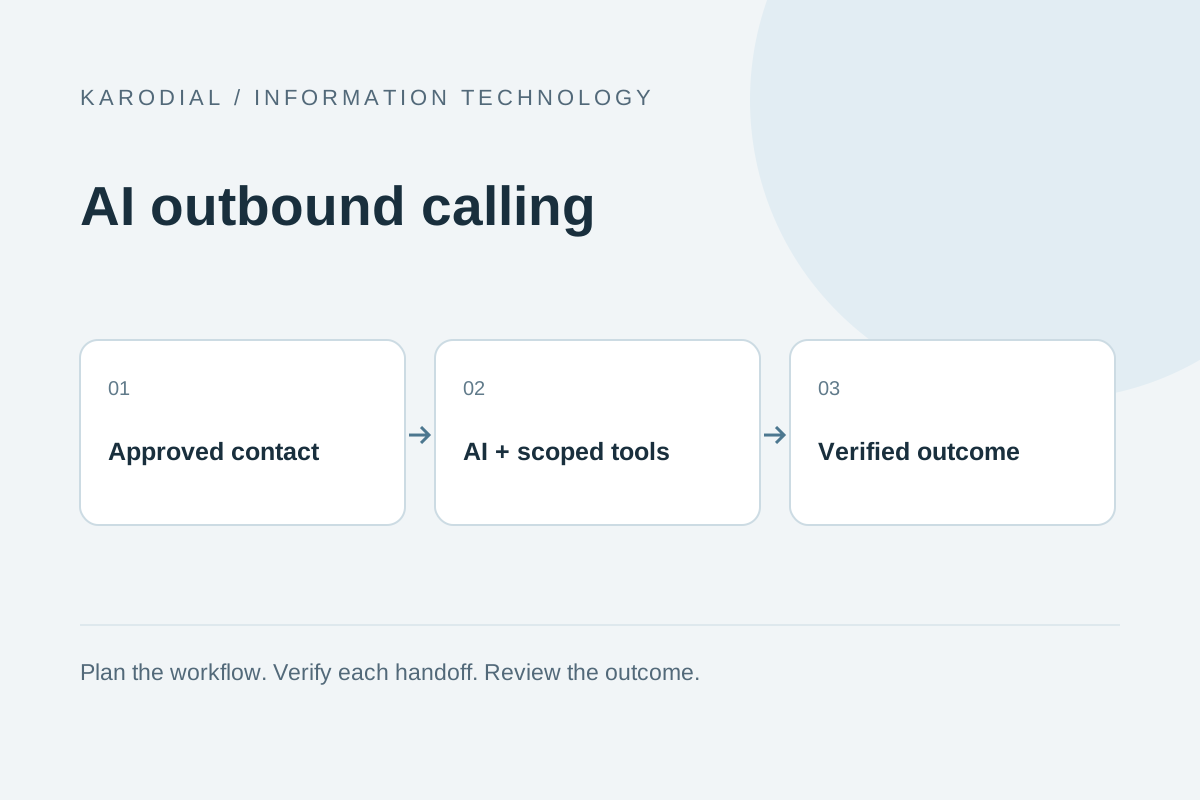
AI outbound calling combines telephone connectivity with a conversational system that can listen, respond and sometimes use business tools. It can support a narrowly defined task such as confirming a requested appointment or following up on an enquiry where contact is appropriate. A convincing voice is only one component. The workflow also needs accurate information, controlled actions and a person who takes over when the conversation exceeds its scope. This guide explains how to evaluate and launch a useful calling process without mistaking a fluent conversation for a verified business result.
Choose a narrow and suitable task
Start with one task whose success can be observed. Confirming an appointment time is easier to evaluate than handling every possible sales conversation. Write what the agent may ask, what it may explain and when it must stop or transfer. Identify topics that need a trained employee. A narrow scope helps the team prepare reliable knowledge and realistic tests.
Check whether a phone call is the appropriate channel. A simple reminder may be better as a message when that matches the customer's preference. An AI call should solve a communication problem, not exist merely because the technology is available. Avoid beginning with high-pressure selling or conversations requiring sensitive judgment. Select a use case where a short, respectful interaction can produce a clear and useful outcome.
Establish identity and appropriate contact
Review the current requirements for the intended recipients, destinations and purpose before dialing. Keep the relevant permission and contact preferences attached to the campaign records. Suppress people who have requested no further contact, including changes received after a batch was prepared. Customer expectations matter alongside provider onboarding and applicable calling rules.
The opening should identify the business and make the automated nature of the interaction clear. Give the recipient a simple way to decline or ask for a human. Do not imitate a real person's voice without appropriate authorization or design the call to conceal who is speaking. If the recipient is unavailable or the wrong person answers, limit disclosure and end or route the call according to the reviewed process.
Understand the conversation components
A calling system needs telephony, audio handling and a conversational model. Some architectures separate speech recognition, language generation and speech synthesis; others use more integrated audio models. Turn-taking, interruptions and response delay affect how usable the result feels. Provider capabilities differ, so review the actual supported architecture rather than assuming every voice agent behaves the same way.
The application also needs business context and permitted tools. A scheduling assistant may read available slots and request a booking. A calling gateway provides the phone connection but does not automatically supply accurate knowledge or safe booking rules. Keep these responsibilities distinct. This makes it easier to investigate whether a problem came from the route, audio recognition, conversational response or a failed business action.
Prepare knowledge and a clear script
Supply maintained facts the agent needs: the business identity, operating hours, approved service information and the specific purpose of the call. Remove contradictory or outdated material. Write an opening, a few expected paths and clear fallback language. A prompt should define boundaries and escalation conditions as well as tone. Friendly wording cannot compensate for inaccurate information.
Use short spoken sentences and ask one question at a time. Prepare pronunciation for names, locations, amounts and appointment times. Confirm important details rather than treating the first recognized phrase as certain. Test Hindi and English independently, including common language switching. A translated script may need different phrasing to sound natural and avoid ambiguous dates or numbers. Review the complete conversation, not just a sample greeting.
Version the approved script and knowledge together. When reviewing a disputed conversation, the team should know which instructions and facts the agent actually had at that time. This makes corrections specific and prevents a later edit from obscuring the cause of an earlier mistake.
Keep tool actions bounded and verified
Give the agent only the tools and data required for its task. A reminder assistant does not need unrestricted customer exports or broad administrative access. Authenticate server-side requests and verify record ownership. Validate proposed arguments, including time zones and available appointment slots. The model's confidence is not a substitute for application rules.
Separate an intended action from a confirmed result. The agent should say an appointment is booked only after the booking system has accepted the correct operation. If the tool fails or its result is ambiguous, explain that a person will review the request instead of inventing success. Use idempotent operations where appropriate so repeated tool calls do not create duplicate bookings or notifications. Keep a useful audit trail without exposing unnecessary private content.
Design human handoff and graceful exits
Recipients may ask something outside scope, become confused or simply prefer a person. Define the handoff route and make sure it works during the actual calling window. If immediate transfer is unavailable, offer an appropriate callback request with a clear record. Do not promise that an employee will call immediately when no such operational process exists.
Handle refusal, silence, repeated recognition errors and interruptions politely. Limit repeated attempts and respect a request to stop. Do not force the conversation to reach a sales outcome. A graceful exit can be the correct result. Give staff enough context for a handoff without requiring the customer to repeat everything. The human team's capacity is part of the design, not an optional feature added after automation begins.
Plan batches, retries and cost controls
Store each intended call as a separate operation with recipient context and a clear purpose. Check permission, suppression and current scheduling conditions again before dispatch. Use bounded batch sizes, concurrency limits and campaign stop controls. A change to the script or audience should be reviewed before it affects a large number of recipients.
Costs can include telephony, conversational processing, speech services, recordings and staff follow-up. Estimates should state their assumptions. Actual billing may depend on duration and provider-specific events. Do not assume that canceling a parent batch stops every accepted call or proves that no usage occurred. Match outcomes and costs to trustworthy provider evidence and the individual call record. Set alerts before scaling traffic.
Evaluate more than a natural voice
Create a test set covering ordinary conversations and difficult cases. Include background noise, short answers, different accents, language switching, interruptions and incorrect customer assumptions. Test tool failures and unavailable human transfers. Use controlled test recipients with invented business data. Compare the transcript, audio and actual records to understand what really happened.
Measure task completion using verified outcomes. An agent saying confirmed is not proof that the scheduling database changed correctly. Track recognition problems, false claims, handoff success, complaints and time spent by employees fixing mistakes. Review failures by their practical impact rather than averaging everything into one impressive score. A pleasant demonstration can hide errors that become costly when repeated across hundreds of calls.
Launch a small, reviewable service
Consider a fictional studio calling customers who requested appointment confirmation. The agent identifies itself, checks whether it is a convenient time, confirms the existing appointment and offers a human callback for changes outside its supported options. A booking update happens through a restricted tool and is announced only after a verified result. Refusals update the appropriate contact preference.
Start with a limited pilot and inspect complete conversations with appropriate access controls. Define recording notice, retention and review responsibilities through the relevant approved process. Pause when the agent makes unsupported promises or fails to respect customer choices. Expand only after the team can explain outcomes and recover from failures. Useful AI outbound calling combines an appropriate audience, a bounded task, truthful conversation and verified actions. The strongest measure is whether customers and staff can rely on the result.