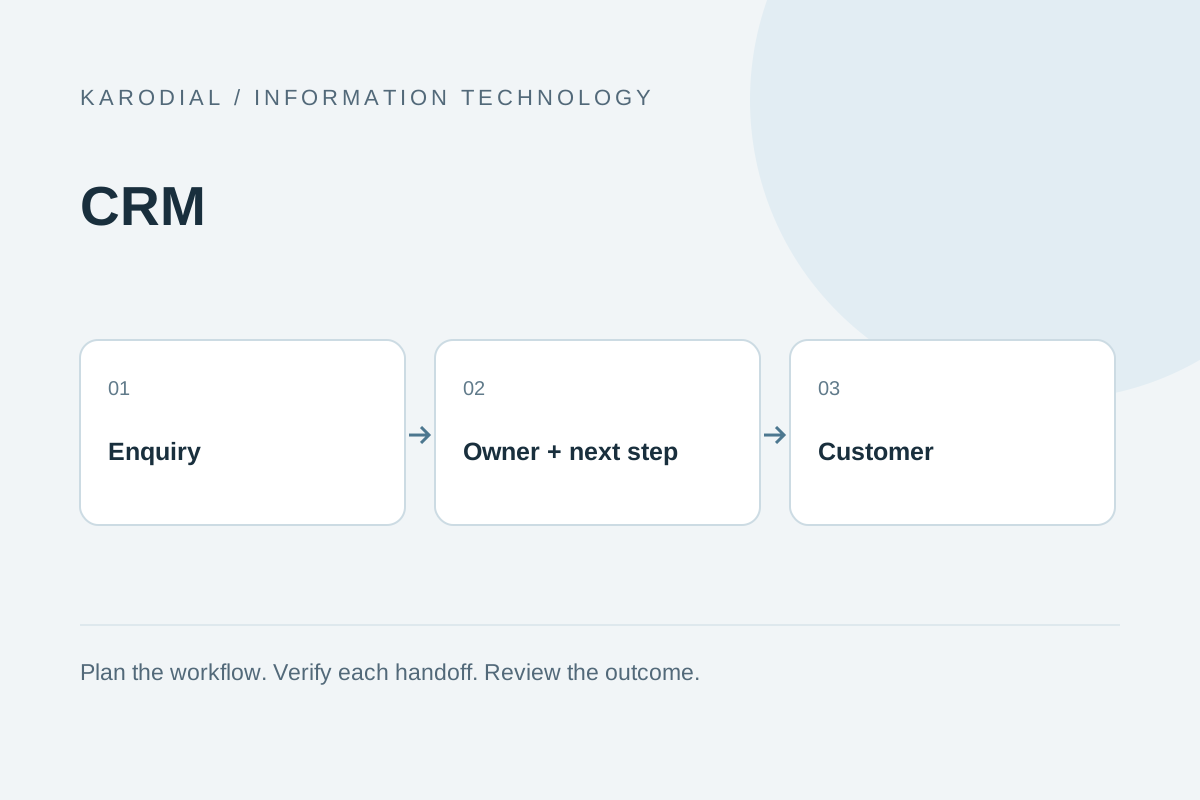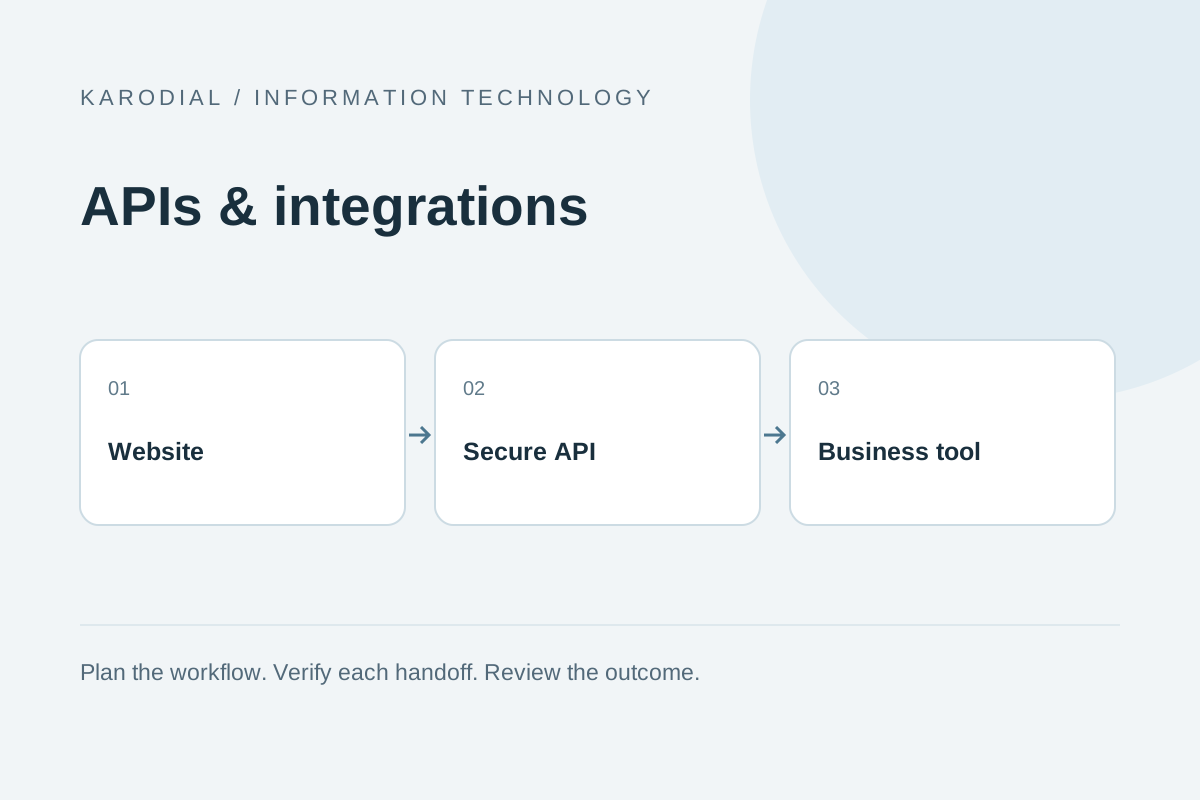
A customer completes a website enquiry, a sales record appears in the CRM and the right employee receives a notification. That useful sequence is an integration. An API is one of the interfaces that makes it possible. Connecting business software can remove repetitive copying, but a successful connection needs more than a request that works once. It needs clear data ownership, controlled access and a plan for incomplete results. This guide follows a practical enquiry workflow to explain how to design integrations that remain understandable after launch.
Start with the business handoff
Describe the handoff before choosing tools. What information arrives, which system owns it and what should happen next? For an enquiry, the website might collect a name, contact method, service interest and permission to respond. The CRM creates a lead and assigns an owner. A notification service then alerts that owner. Each step should have a specific purpose and a measurable result.
Decide which information is genuinely needed. Sending an entire customer profile because the destination accepts it creates unnecessary exposure and mapping work. Agree on required fields, allowed values and what happens when information is missing. Name a business owner who can resolve ambiguous cases. Integration projects often fail through unclear responsibility rather than a difficult programming language. A short written workflow gives both developers and operational staff a shared definition of success.
Understand an API contract
An API describes how one system can request information or ask another system to perform an action. A request normally includes a destination, a method, authentication and any required data. The response describes the outcome according to that API's contract. JSON is common, but not universal. Read the actual documentation rather than assuming that every service uses the same fields and status meanings.
Distinguish successful transport from a completed business action. A response may mean a job was accepted for later processing. Another response may contain validation problems or a partial result. Save the operation identifier and examine the relevant status details. Versioned contracts can also change over time. Keep a record of the API version your integration uses and review provider change notices before a previously working connection becomes difficult to diagnose.
Keep credentials and permissions controlled
Credentials establish an application's authority to use a service. Keep secret keys on the server, outside public assets and source reports. Give each integration only the permissions it needs. A website creating enquiries usually does not need authority to export every customer or delete historical records. Use separate development and production credentials where the provider supports them.
Plan credential rotation and account ownership before launch. If a contractor's personal account owns the only working connection, the business may struggle when that person leaves. Document who can revoke access and how recovery works without copying secrets into the documentation itself. Avoid placing tokens in URLs because URLs can appear in logs and browsing histories. Authentication should support a clear responsibility boundary, not become an invisible dependency that nobody is willing to change.
Map data deliberately
Systems rarely describe the same concept in exactly the same way. One might store a complete name while another expects separate fields. A phone number may arrive without a country code. A sales status may have a different set of permitted values. Write down these differences and define how the integration handles them. Avoid silently guessing critical information.
Choose a source of truth for each important field. The CRM may own lead status while the website owns the original enquiry message. Keep stable external identifiers so records can be matched without repeatedly searching by a mutable email address. Decide how duplicates are detected and when records may be merged. Preserve original evidence when a transformation could lose meaning. Data mapping is business reasoning expressed in code, so the team responsible for the workflow should review it.
Design for repeated requests
Networks fail, users click twice and background workers retry. An operation that creates a new record should have a strategy for repeated submissions. Some APIs support idempotency keys. Others require your application to maintain a durable relationship between its operation and the provider's identifier. The goal is to avoid creating a second lead or triggering the same communication simply because a response was delayed.
A timeout does not prove that the remote action failed. The provider may have accepted the request before the connection closed. Preserve enough evidence to investigate or reconcile the operation. Classify errors: invalid data needs correction, missing authority needs access review and temporary unavailability may justify a bounded retry. Blindly retrying everything can turn a small outage into duplicate records, excess spending or a growing backlog.
Respect limits and background work
APIs can impose rate limits, payload limits and account quotas. Read those constraints and build bounded processing around them. Use queues for work that can happen after the customer receives a response. A website should not freeze while it waits for several independent notifications. Show an accurate state, such as enquiry received, rather than promising that every connected system has finished.
Limit concurrency and use provider guidance for retry timing. Add backoff for temporary failures and stop repeated attempts when authentication is broken. A queue needs monitoring and an escalation path; storing failed tasks forever is not a recovery plan. Decide which jobs can be retried automatically and which need human review. Protect the original operation from being lost when a secondary integration is temporarily unavailable.
Combine APIs and webhooks appropriately
An API request often starts an operation. A webhook can report a later event, such as a delivered message or a completed background task. Treat the webhook as an incoming request that needs authentication or signature verification according to the provider. Match it to an existing operation and process repeated deliveries safely. Do not trust a status simply because it arrived at a URL you created.
Events can arrive late or in an unexpected order. Keep rules that protect confirmed final outcomes from being overwritten by older intermediate updates. If a service provides a supported reconciliation method, document when it may be used. Different providers have different delivery guarantees, so avoid copying one platform's assumptions into another connection. A clear state model helps the application turn technical events into useful information for employees.
Test a full workflow with invented data
Test beyond the first successful request. Send missing fields, invalid values, duplicate submissions and responses that arrive after a delay. Temporarily disable a destination in a controlled environment. Check whether the original enquiry remains available and whether staff can see what needs attention. Verify that logs contain helpful identifiers without exposing credentials or unnecessary personal content.
Use test accounts and invented contact details. Do not trigger real customer messages merely to demonstrate that an integration works. Validate permissions as well as functionality: the connection should be unable to perform actions outside its intended scope. Compare records across systems after a small batch. A useful acceptance test follows the business result from beginning to end, including what employees see when a step does not complete normally.
Operate the connection after launch
For the fictional enquiry flow, the website first saves the request, then queues CRM creation and owner notification. Each task has a status and a correlation identifier. If the CRM is unavailable, the enquiry remains visible for staff review. When service returns, recovery uses the saved operation rather than asking the customer to submit everything again. This makes failure manageable without hiding it.
Assign responsibility for alerts, provider changes and periodic access reviews. Track useful measures such as processing delay, unresolved failures and duplicate prevention. Keep the data contract and recovery procedure close to the code. Compare ongoing subscription and usage costs with the manual work actually removed. Good integration is a maintained business capability. Its value comes from accurate handoffs and recoverable operations, not simply from the number of services listed on a diagram.