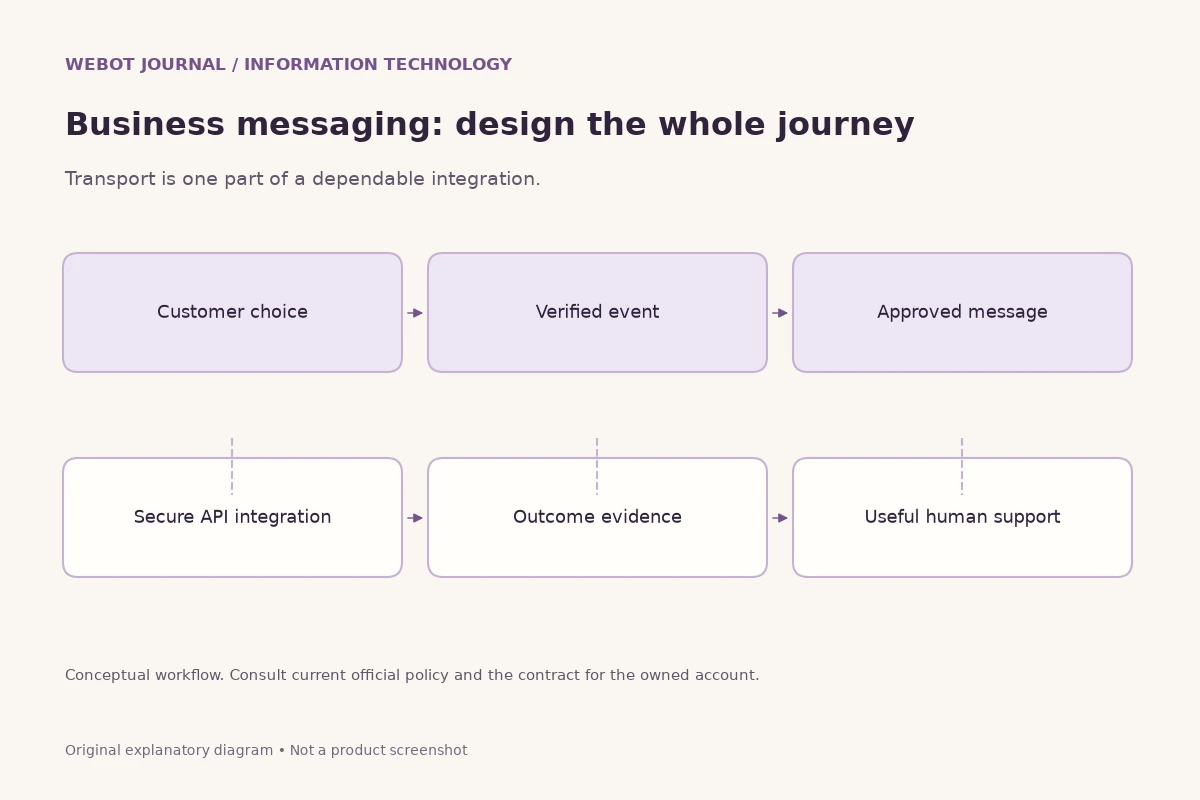
The phrase WhatsApp Business API usually refers to integrating software with the WhatsApp Business Platform. It is useful when messages need to connect with business events, customer support or other systems. It is also easy to underestimate. A working send request is only one part of a dependable service: the business still needs permission, accurate data, secure access, evidence of outcomes and people who can handle exceptions.
This guide explains the essential product distinctions and develops an original implementation framework. It separates current official policy facts from general engineering recommendations and illustrative examples. It does not publish credentials, fixed price quotations or a ready-to-run request that may become obsolete. Review Meta's current documentation, the owned account's eligibility and any chosen provider's terms before building. Country availability, account configuration, message categories and commercial conditions can affect the actual integration.
1. Decide whether you need an API
A software interface is appropriate when a business process needs to initiate or manage communication programmatically. For example, an order system may need to notify a customer after a confirmed event. A support system may need to connect conversations with an internal case. The WhatsApp Business Platform supports business integration; it is distinct from the small-business app and the ordinary personal app. Choose based on workflow rather than the impression that API access is automatically a better product.
Write the requirement as a sequence that someone outside engineering can understand. Identify the business event, intended recipient, necessary message, expected response and responsible team. If the sequence cannot be explained clearly, adding software will probably amplify the confusion. A manageable manual inbox can remain suitable for a small operation. An API becomes worthwhile when the organisation is ready to own the integration and the work around it, not merely because a demonstration can send one message quickly.
2. Choose a direct or partner-supported setup
The official Platform overview describes direct integration and partner-supported onboarding as different setup approaches. Direct integration gives a capable development team responsibility for more of the technical implementation. A partner can provide additional onboarding, interfaces or support according to its offering. Neither approach removes the business's responsibility for appropriate communication or guarantees that every optional feature is included.
Compare concrete responsibilities before signing up. Who owns the business account and phone identity? Who maintains the integration? What happens if the organisation changes provider? Which charges come from Meta and which come from the partner? Ask for clear answers about access, support and data handling. A low apparent entry price can be less useful than a well-understood service boundary. Do not assume that an attractive dashboard means the provider owns your business relationship or that switching later will be effortless.
3. Establish account and identity ownership
The sending identity should belong to the organisation represented in the messages. Before onboarding, decide who may administer the account and who can approve changes. Keep business information accurate and consistent with what customers expect. Avoid using a temporary employee's personal access as the only route to a production service. Account ownership is operational infrastructure, not an administrative detail to postpone until after launch.
Read current onboarding and number-use guidance for the actual account. Eligibility, verification and supported coexistence or migration options can change; a generic tutorial should not instruct you to delete or move an existing number without reviewing the consequences. Make an inventory of the identity, current communication process and records that must remain available. Test a planned transition with the responsible owners before interrupting an established customer channel. A successful new registration does not automatically prove preservation of every historical workflow.
4. Obtain understandable customer permission
WhatsApp's current Business Messaging Policy requires an appropriate recipient relationship, including opt-in permission for subsequent business messages or calls, and requires businesses to respect stop requests. Treat that as a design input rather than a sentence hidden in a launch checklist. Explain the sender and purpose clearly when collecting a customer's choice. An unrelated contact list is not a substitute for an expected conversation.
Keep a practical internal record of how the person selected the channel and which kinds of updates they requested. Separate requested service communication from optional promotional content. Staff should be able to honour a stop request without searching across disconnected spreadsheets and campaign tools. A technical system can help enforce those choices, but it cannot invent consent that never occurred. Review the actual activities and applicable requirements with the appropriate responsible advisers where necessary; an API integration does not certify legal compliance for every jurisdiction.
5. Understand templates and the service window
The official policy distinguishes business-initiated approved templates from replies within the customer service window. The current window lasts 24 hours from the user's latest message and resets when the user sends another message. Outside that window, approved templates are required for business messages. Logging into a dashboard, having an old conversation or possessing the recipient's number does not create a new customer message.
Implement the rule from verified events, not from a staff member's memory. Show operators the appropriate state and make it clear why a particular message type is available. Review templates for a specific purpose and avoid treating approval as permission to send any substituted text. If a template changes meaning, return it to the appropriate review process. Keep the current official policy linked in operational documentation, because a remembered rule can become outdated even when an old integration still appears to work.
6. Choose message categories honestly
The current pricing overview describes marketing, utility, authentication and service messaging. These categories reflect different purposes; they should not be chosen merely to obtain the cheapest apparent route. A promotional offer is not made transactional simply by including an order reference. An authentication message should support the intended verification journey rather than conceal an unrelated advertisement.
Create an internal review that asks what the customer expects and what event justifies the message. Keep a plain-language example for each approved use case so product, support and engineering teams share the same interpretation. Where classification is uncertain, consult current official guidance before expanding the send. Accurate categorisation supports predictable operations and clearer customer communication. It also makes commercial estimates more meaningful, because a budget built on the wrong type of message can misrepresent the cost of the actual campaign.
7. Protect credentials and administrative access
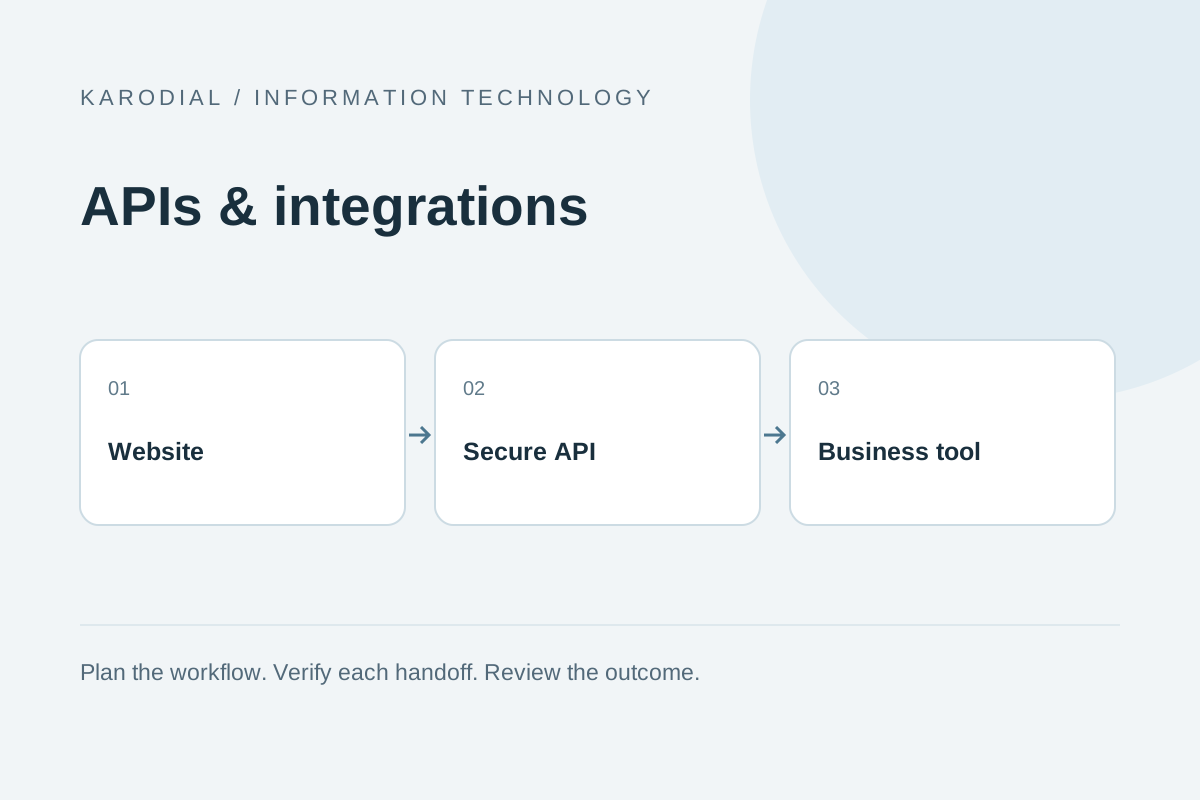
API access should be implemented server-side with protected credentials. Do not place tokens in browser code, public mobile bundles, support tickets or shared screenshots. Use the current official authentication guidance for the integration being built. Give people only the access needed for their role, and establish a controlled process for changing administrative permissions or replacing a credential.
Keep secrets out of normal logs while retaining useful operational identifiers. A developer should be able to investigate a failed request without seeing every customer's message and every authorisation header. Test environments and production environments should have clear ownership and separation wherever the actual account tools permit it. If a credential is exposed, follow the documented revocation and replacement process promptly. Editing a repository file does not make a previously published token private again, and a chat message is not an appropriate long-term secrets store.
8. Build from a verified business event
Start the notification from an authoritative record. An order confirmation should follow a committed order, while a shipping notice should follow reliable fulfilment evidence. Do not send a completed-payment message merely because a customer reached a browser page labelled success. The underlying business system must establish the fact before the communication system announces it. Otherwise, automation can make a temporary interface mistake look like an official promise.
Record the intended notification with enough context to identify the triggering event, recipient and template. Consider repeated events, cancelled orders and late updates before launch. An internal deduplication key can prevent your own workers from creating the same intended send twice. It does not prove that an external request timed out before being accepted. Keep that distinction explicit so a retry policy does not quietly turn uncertain network outcomes into duplicate customer messages.
9. Design inbound handling and human escalation
A notification channel can become a support channel as soon as a customer replies. Decide where that reply goes and who is responsible for it. The official policy requires clear escalation options when automation is used. A bot that can answer a few routine questions should not trap the customer when their issue falls outside the scripted flow or when the underlying order needs human attention.
Map the handoff in ordinary terms. Which questions can automation answer from verified data? When should a person take over? How will staff see the conversation context without receiving unnecessary sensitive information? Do not promise continuous human support unless the organisation actually provides it. Publish realistic expectations and ensure that a customer can obtain help through the offered route. The quality of the integration depends as much on the reply journey as on the first outbound message.
10. Treat callbacks as operational evidence
Current official developer documentation describes webhook-based event handling for the Cloud API. Implement the verification and request-authenticity requirements from that documentation rather than copying an unexplained code fragment. The receiving system should process only events it can associate with the correct owned integration and operation. A publicly reachable URL by itself is not proof that the data arriving there is trustworthy.
General event-handling practice also requires resilience. Events may need deduplication, safe processing and a durable record before downstream work proceeds. Protect the endpoint from turning repeated deliveries into repeated business actions. Record useful identifiers and timestamps, and define what happens if a downstream system is unavailable. This article does not specify a substitute signature algorithm or an invented callback payload. Those details belong to the current official contract and must be verified for the exact integration you deploy.
11. Keep accepted, delivered and understood separate
An accepted API submission is not proof that the recipient read the message. Delivery evidence and read evidence are different facts, and a business result such as a confirmed appointment is another fact again. Build reporting that preserves those distinctions. An operator should not see a successful customer outcome merely because an HTTP request returned without a connection error.
Avoid interpreting unavailable evidence as a negative judgment about the customer. A missing read event does not establish that someone deliberately ignored a message. Similarly, a delivered reminder does not prove that the customer attended. Use the appropriate business record for each outcome. A useful dashboard explains what is known, what is still pending and which action is available. Honest uncertainty is more useful than a reassuring success rate calculated from states that measure different things.
12. Plan retries around known and unknown outcomes
Classify errors before deciding what to repeat. Invalid fields call for a request correction. Access failures call for a credential or permission review. A temporary network failure may justify a bounded retry, but only after considering whether the original operation could already have been accepted. Do not build one automatic loop that treats every failure as an invitation to send again immediately.
Persist enough context to investigate an ambiguous result and use the documented platform evidence available to your account. Do not invent an idempotency header or assume that a partner's behaviour applies to direct integration. Rate limits and restrictions should lead to controlled backoff and review, not identity rotation or attempts to bypass enforcement. The operational objective is a single justified customer communication with traceable evidence, rather than the largest possible number of submission attempts.
13. Estimate costs from current rates and assumptions
The current official pricing page describes charging on delivered messages, with rates varying by recipient market and category. It also describes no-charge service messaging and certain utility responses within the customer service window, alongside other conditional pricing arrangements. Review the live rate card and applicable conditions rather than copying a fixed rupee amount into a long-lived article or business forecast.
Build the budget from your actual proposed workload. Identify recipient markets, expected message categories, likely delivery and any partner fees. Keep assumptions visible and revise them with observed records from a controlled pilot. A Meta messaging charge, a partner subscription and your own staff or infrastructure costs are distinct components. A free category of platform message does not make the entire service costless. Commercial planning improves when the estimate states what it includes instead of advertising a universal price that cannot fit every account and use case.
14. Protect data beyond the transport layer
Message transport is only one part of the information journey. A customer record may also appear in a CRM, application queue, support inbox and log store. Identify those copies and decide who needs access. Prefer an internal reference over an unnecessary sensitive detail in the message body. A concise notification can direct the customer to an appropriate authenticated process rather than carrying every piece of account information inside chat.
Review partner and business processing arrangements before making broad privacy claims. The recipient business can access the information sent to it, and staff handling or exports can introduce additional exposure. Define practical retention and deletion responsibilities for the systems you control. Avoid describing a service as automatically compliant or completely private without evidence for the actual deployment. A security property of one component is not a certification of the entire organisation's behaviour.
15. Test permissions, failures and customer understanding
A meaningful test plan includes more than one successful send. Confirm that the correct identity and template are used, variables are accurate and the message reaches an agreed test recipient. Then test invalid data, missing access, repeated internal events, delayed processing and an ambiguous network result. Check that the application explains these states without leaking secrets or unnecessary customer content.
Review the recipient experience as well. Does the message identify the sender and purpose? Is the next action clear? Does the reply route work? A technically valid message can still confuse someone if it contains an unexplained reference or a misleading link. Use controlled data and participants who have agreed to the test. Do not turn an integration test into an unsolicited campaign against a live customer database merely because a production credential is available.
16. Work through an appointment-reminder example
Imagine a service business whose customers have chosen WhatsApp appointment updates. The scheduling system records a confirmed appointment, and the notification workflow checks the intended recipient and approved purpose. It selects the appropriate current template and records the dispatch context. If the appointment changes, the system distinguishes a genuinely new update from repeated processing of the old event. This design begins with business truth rather than the mechanics of an API call.
Now consider a customer replying that the time no longer works. The business needs a real rescheduling process and a responsible person or verified automation flow. A reply cannot simply disappear because the original project was labelled outbound notifications. Finally, imagine a timeout during submission. The application should investigate the available evidence before creating a duplicate reminder. These ordinary cases reveal why reliable messaging requires coordination among engineering, operations and customer service.
17. Maintain the integration after launch
Assign owners for account access, template changes, documentation review, commercial reconciliation and customer escalations. Keep a concise operational record of the supported workflows and known limits. When product or policy changes occur, review their effect on the actual implementation rather than assuming that an old successful deployment remains correct forever. Maintenance should be a planned responsibility with time allocated to it.
Monitor real evidence appropriate to the business objective. Message submission counts alone do not tell you whether customers received useful information or whether support questions were resolved. Review errors and a small authorised sample of conversations for clarity. Keep financial records and platform evidence aligned without inventing missing outcomes. If a feature is not ready for the account or region, state that limitation clearly and provide an appropriate fallback rather than hiding it behind a generic automation label.
18. Write a launch brief that exposes unresolved questions
Before launch, create a brief that a business owner and an engineer can review together. Start with the customer problem and the exact event that triggers communication. Name the account owner, the intended audience, the approved message purpose and the person responsible for replies. State the fallback if the channel is unavailable. This should be a working description of one supported journey, not a long inventory of every feature a vendor has ever advertised.
Include a concrete example with fictional data and explain where each field comes from. If an appointment time is calculated, identify the authoritative time zone. If a link requires authentication, check the experience after the customer opens it on another device. If a customer asks to stop future optional messages, explain which system records that choice and how future dispatch checks it. These details reveal gaps that a diagram containing only application, API and customer would hide.
Then list unresolved questions in plain language. Perhaps number migration is not yet approved, a partner charge is unclear or a service team has not accepted responsibility for evening replies. Assign an owner to each question and avoid describing the flow as production ready until the necessary answers exist. An unresolved issue can be managed when it is visible; it becomes a customer surprise when it is replaced by an optimistic assumption.
Finally, record the evidence needed to consider the pilot successful. That may include correct identity, accurate content, controlled duplicate handling and a useful reply experience. A launch brief is valuable because it makes the organisation's intended behaviour reviewable. It also gives the next maintainer a way to understand why the integration exists, which boundaries matter and what should be checked when the product or business process changes. Keep the brief accessible to the authorised team and update it when a verified decision changes the workflow, so that operational knowledge survives individual staff changes.
19. Compare DIDLOO and WhatsApp on the right basis
DIDLOO's Business Messaging API and the WhatsApp Business Platform operate on separate networks with separate identities, approvals and contracts. Similar ideas such as templates and business replies do not make them interchangeable transports. Compare the customers you can appropriately reach, the current supported workflow and the effort required to operate each service. Do not imply that DIDLOO is a WhatsApp API provider or that one registration makes recipients reachable on both networks.
A sound decision identifies the channel, purpose and responsible owners, then validates a small workflow with real evidence. Expand when the organisation can preserve permission, accurate business data, secure access and useful human support. The best integration is one customers understand and staff can maintain. Technical capability is valuable when it serves that complete communication journey rather than becoming an isolated demonstration of message volume.
Sources and further reading
- WhatsApp Business Platform
- WhatsApp Business Messaging Policy
- WhatsApp Business Platform pricing
- Meta: WhatsApp Cloud API documentation
- Meta: WhatsApp Cloud API webhooks
Originally published by WeBot. Republished on KARODIAL on 29 October 2026. View original article