A convincing voice or realistic video can make a false claim feel immediate and personal. Synthetic media can imitate a familiar person, invent a statement or place a real face in a fabricated situation. Yet ordinary editing, compression and missing context can also make genuine material look strange. The useful skill is not guessing from one visual flaw. It is a verification process that separates what the media appears to show from what reliable evidence establishes. This guide offers a practical approach for individuals and business teams without promising certain deepfake detection.
Separate authenticity from truth
A video can be genuine and still mislead through an incorrect caption, an old date or a missing earlier sentence. A synthetic illustration can be clearly labeled and used honestly. Ask two questions: how was the asset created, and is the claim being made about it supported? The answers are related but not identical.
Write the actual claim in plain language. A clip showing someone speaking is different from a claim that they approved a payment or endorsed a product. This step prevents attention from narrowing to pixels while the more important contextual claim goes unexamined. Verify the action or event that matters, not only the appearance of the file.
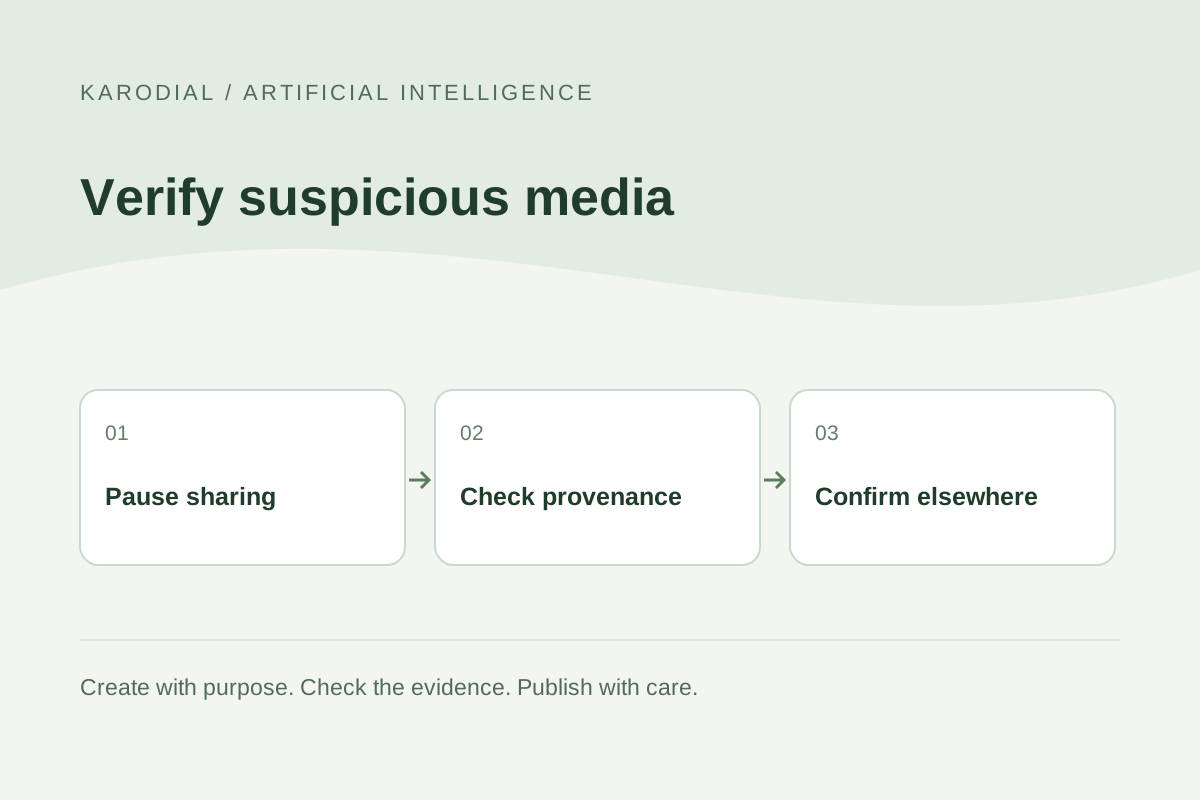
Pause before acting or sharing
Urgency, fear and secrecy can push a viewer to act before checking. Treat an unexpected request for money, credentials or confidential information as a reason to slow down. A voice sounding like a colleague or family member is not sufficient proof of identity. The FTC specifically advises verifying a purported family emergency through a known number.
Do not use contact details supplied only by the suspicious message for confirmation. Reach the person or organization through a previously established channel. If you cannot reach them, seek another trusted route before making a consequential decision. The point is to independently verify the request rather than debate whether a few seconds of audio sound artificial.
Find the original source
Identify who first published the material and where the complete version can be found. A forwarded clip with a familiar logo is weaker evidence than a verified publication from the relevant organization. Search for an earlier upload, the event described and a longer recording. Compare dates, locations and the surrounding explanation.
Be cautious with accounts whose names resemble an official organization but have no established relationship to it. Inspect the actual source rather than relying on a screenshot of a profile. A repost can remove context even when the video itself has not been altered. Note what remains unknown and avoid turning a lack of source information into a confident accusation.
Examine clues without overstating them
Unusual mouth movement, inconsistent lighting, abrupt audio changes and unstable facial details may justify closer inspection. However, low bandwidth, editing, dubbing and camera conditions can create odd effects in real recordings. Better synthetic systems may also avoid familiar flaws. No single visual or audio clue should carry the whole conclusion.
Review the full sequence at an appropriate speed and compare related frames or audio passages. Look for consistency with the claimed event, not just aesthetic perfection. If a clip appears suspicious, describe the specific uncertainty. Saying that a feature deserves checking is more accurate than declaring it fake because one compressed frame looks distorted.
Use provenance as supporting evidence
Content Credentials based on C2PA can record information about an asset's origin and changes in a tamper-evident structure. The C2PA explainer makes clear that provenance verification is not a judgment that the underlying content or claim is factually true. Consider who signed the information and what history is actually available.
Missing credentials are not proof of fabrication. Not every camera, editor or platform uses a compatible workflow, and files can lose associated information during processing. This is a practical reason to combine provenance with other checks. A signed history can help answer creation questions, while independent reporting and direct confirmation still matter for what the content claims.
Treat detector results as limited signals
A detector may provide evidence about a particular file under particular conditions. It does not automatically establish the identity, intention or truthfulness of the speaker. Performance can vary with media type, transformations and the content the detector was evaluated on. NIST describes multiple transparency and detection approaches and emphasizes that no single technique is a comprehensive solution.
Read what a tool actually claims to detect and whether the result applies to the file you submitted. Avoid uploading private customer recordings to an unfamiliar service simply to obtain a score. Check its data handling first. A numerical confidence display should not replace a reasoned account of the source, context and independent evidence.
Corroborate the important event
Look for confirmation through the relevant institution, direct participant or established reporting. Multiple websites repeating the same unsupported clip are not necessarily independent sources. Trace their evidence. For a supposed business announcement, check the organization's own communication and contact it through a known route if the claim would affect a decision.
Compare what each source actually confirms. One may establish that an event occurred without verifying the quoted statement. Another may show that the clip is old. Keep those findings separate. If the evidence remains incomplete, retain an unverified status rather than forcing a binary real-or-fake answer. Responsible uncertainty can prevent both deception and a false allegation.
Create a simple business response
Imagine a fictional company using a KARODIAL website receives an audio message that appears to come from its director. The message demands an urgent change to a payment destination. The employee pauses, contacts the director through an established channel and follows the company's approval process. Whether the audio is synthetic is secondary to verifying the instruction before acting.
Prepare similar procedures for public statements, customer complaints and impersonation of support staff. Keep approved contact routes visible on the website. Staff should know where to report suspicious media internally and who can issue a correction. Do not let an unfamiliar voice note bypass ordinary authorization simply because it sounds persuasive.
Preserve evidence and explain conclusions
Keep relevant links, timestamps and the original file where safe and appropriate. Record what was claimed, what you checked and what each source established. Avoid spreading private or harmful content while asking others to inspect it. Use the platform's reporting process or an appropriate local authority when needed, and provide a factual account rather than an unsupported certainty.
If publishing a correction, explain the specific evidence and any remaining limits. Update it when reliable new information arrives. Effective deepfake awareness combines technical clues, source investigation and independent confirmation. The goal is not to become confident at guessing. It is to make better decisions when realistic media asks for trust that has not yet been earned.