An AI assistant can explain a difficult sentence, suggest practice questions or point out a gap in an argument. It can also make incorrect answers sound convincing and complete a task before the student has done any thinking. The difference lies in the learning process you design around it. A useful goal is to become more capable when the tool is closed. This guide offers practical study workflows and a fictional website-learning example. It does not assume that every course allows the same assistance or that every generated explanation is reliable.
Begin with the learning objective
Write down what you should be able to do independently. Understand a concept, solve a type of problem, interpret evidence and write an argument are different objectives. If the goal is understanding a web form, ask what information moves between browser and server rather than merely requesting finished code. The objective determines what help is useful.
Try the task first, even briefly. Mark the exact step where you become uncertain. A specific question such as why server validation is still needed after browser validation is more productive than asking the model to do an entire assignment. Keep your original attempt. It provides evidence of your starting understanding and lets you compare the help with the work you could already perform.
Ask for a hint before a solution
Tell the assistant what you tried and request the smallest useful next hint. For example: I understand how a form collects text, but I cannot explain why the server checks it again; ask one guiding question and do not write the final answer yet. After responding, explain the idea in your own words before asking for more help.
If a complete answer appears immediately, pause and rebuild the reasoning yourself. Change a condition and see whether you can still explain the result. In mathematics, vary the numbers; in programming, change an input; in history, compare a second source. Copying a fluent solution may finish the page without improving understanding. Hints are useful when they keep you engaged in the decisions the task is designed to teach.
Use worked examples and retrieval practice
Ask for an example at the level you are studying, then identify each step. Request a second problem with a similar method but different details. Solve it without looking at the worked version. Finally, ask for feedback on your own answer. This sequence turns the tool into a practice partner instead of a substitute author.
Create short recall questions after studying a topic and answer them with the notes closed. Check the answers against trusted course material. Generated questions can be ambiguous or test something the course has not covered, so review them rather than accepting every item as a good assessment. Track recurring errors. If you repeatedly confuse two concepts, ask for a comparison and then create your own example demonstrating the difference.
Check explanations against reliable material
A clear explanation can still contain a false claim, an invented citation or an invalid calculation. Use your textbook, teacher-provided materials and appropriate primary sources to verify important points. Open cited sources and confirm that they actually support the statement. A realistic-looking reference is not evidence merely because it includes an author and a publication date.
For a technical topic, compare examples with official documentation and run safe tests where appropriate. For an argument, identify which statements are facts and which are interpretations. Ask the assistant to state uncertainty, but do not treat its confidence label as an independent check. Verification is part of learning the subject. It teaches you how to recognize a strong explanation rather than simply choosing the version that sounds easiest.
Use feedback without surrendering authorship
Bring a draft you wrote and ask for focused feedback: which paragraph lacks evidence, which sentence is unclear or where the conclusion goes beyond the material? Review the suggestion and decide how to revise. You should be able to explain why the change improves the work. Replacing every paragraph with generated prose can erase your reasoning and hide what you still need to learn.
Keep a simple revision record when the course requires it. Separate an editing suggestion from a new factual claim that needs checking. If the assessment is designed to evaluate your own writing or unaided problem solving, follow its limits. Different institutions and assignments set different rules. Ask the teacher when the allowed boundary is unclear rather than assuming that assistance acceptable in one task is automatically acceptable in another.
Protect data and use appropriate access
Do not upload classmates' personal details, private school records or confidential project material into an unapproved service. Remove unnecessary identifiers from examples. Follow the tool's age requirements and the institution's rules for access. A student should not bypass an age restriction or account policy because a tutorial suggests an easier way to log in.
UNESCO's guidance emphasizes human agency, privacy and educational review. The practical implication here is to keep learning decisions with students and educators, while choosing tools that suit the context. A service's popularity does not establish that it is approved for your school. Use authorized alternatives when necessary. There are useful study methods, including explaining aloud and solving new problems, that do not depend on sending private material to any online tool.
Build a project you can explain
Consider a fictional student learning how websites handle enquiries. They first draw the browser, server and stored record on paper. AI helps identify a missing validation step. The student then builds a small practice form using invented data, tests empty fields and repeated submissions and explains each result. They label the project as practice rather than presenting it as a commercial deployment.
The final evidence includes the student's code, test notes and a plain-language explanation of the flow. If AI suggested code, the student checks it and identifies the changes they made. The learning outcome is not the number of files produced. It is the ability to describe the decisions, diagnose an error and apply the method to a new situation without depending on a copied solution.
Make a study routine that ends without the tool
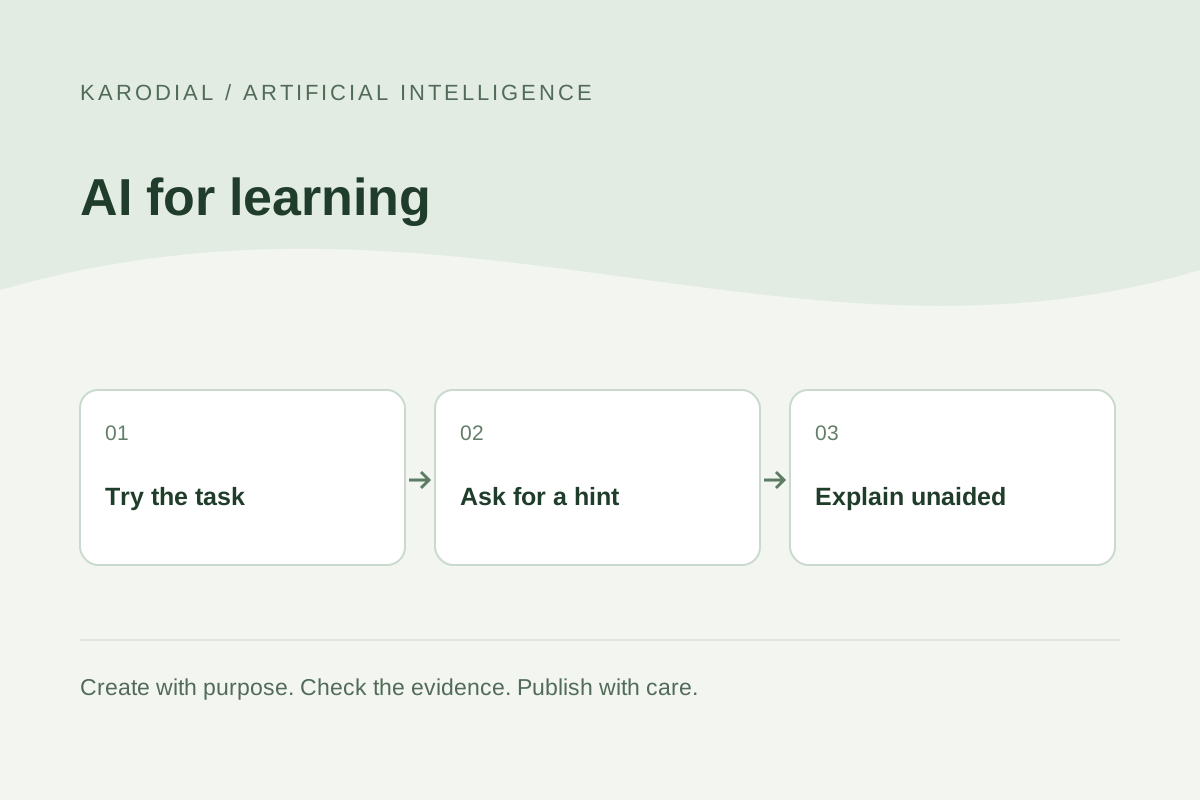
Use a short cycle: attempt the work, ask a focused question, verify the explanation, practice a variation and explain it unaided. At the end of a session, write what you learned and what remains uncertain. Plan the next practice task around that gap. This keeps the process connected to your progress rather than the assistant's output volume.
Before an exam or assessment, practice under the conditions you will actually face. If the tool will not be available, rehearse without it. If approved assistance is allowed, learn its boundaries and keep responsibility for your answer. AI can support explanation, feedback and practice, but successful study leaves you with knowledge you can use independently. The strongest sign of progress is being able to solve or explain something today that you could not manage yesterday.