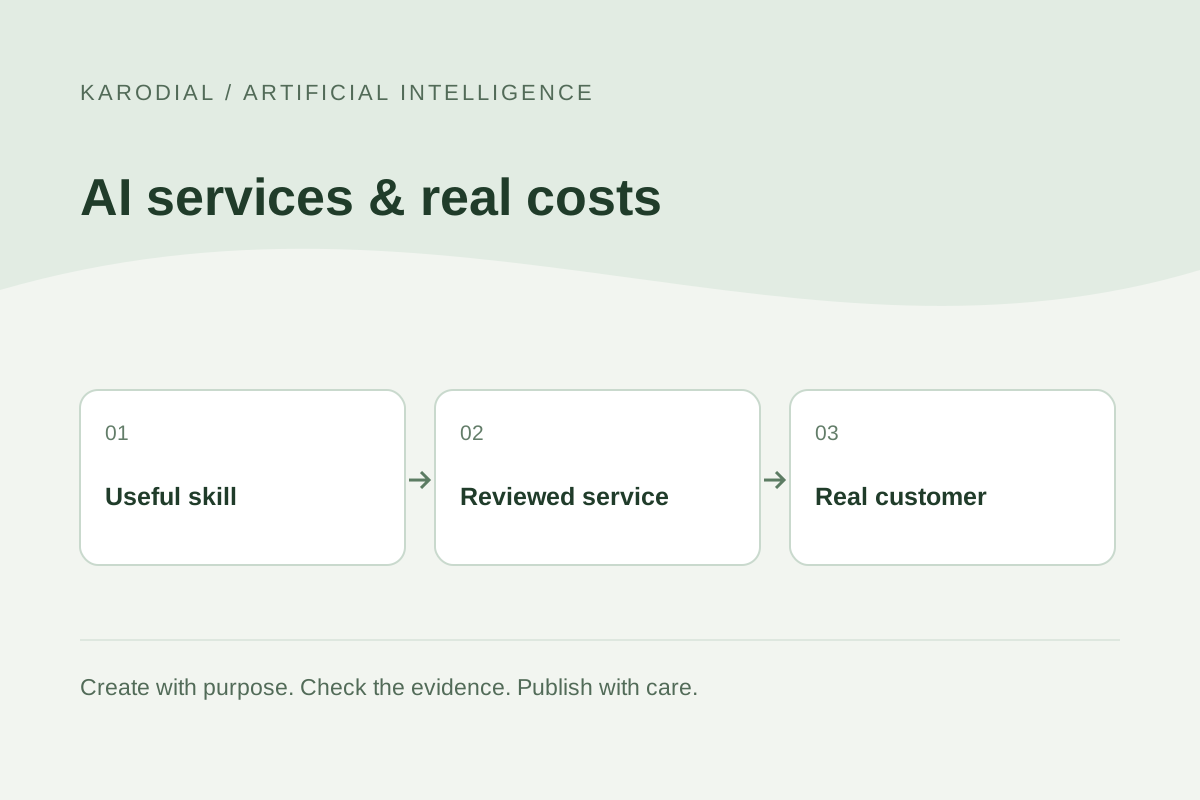
AI can help someone deliver useful work, but it does not create customers, judgment or a dependable income by itself. A business pays when a service solves a real problem: clearer website content, reviewed product images, a working enquiry process or understandable training material. The useful starting question is therefore not which AI tool prints money. It is which customer problem you can competently solve and verify. This guide uses a fictional local business project to explore services, costs and delivery. It contains no forecast of what an individual will earn.
Start with a service you can check
Choose a problem you understand well enough to evaluate the result. Someone experienced in writing might offer reviewed service-page drafts. A designer might prepare image variations using authorized source material. A developer might build a bounded enquiry integration. The AI output is a draft or component; the paid service includes selecting, checking and delivering something fit for use.
Avoid selling expertise you do not have merely because a model produces confident answers. A website description and professional advice carry different responsibilities. Define what the service covers and when a specialist must review it. Make a small sample using invented business details before approaching a customer. If you cannot explain why the sample is accurate and useful, acquiring a more expensive tool will not resolve the underlying gap.
Turn an idea into a concrete deliverable
Vague offers such as complete AI transformation are hard to price and harder to accept. Describe the actual outcome. For a fictional furniture workshop, an initial service might include five reviewed website pages, a set of accurately labeled product photographs and a tested contact form. State the input information, number of revisions, file formats and responsibilities.
Ask the customer to approve the underlying facts: materials, dimensions, delivery areas and contact details. AI should not invent these to make the offer more attractive. Provide a preview and a written acceptance checklist. A service becomes commercially understandable when both sides know what finished means. This also prevents a modest content project from silently expanding into account management, photography, advertising and software maintenance under one unclear fee.
Build evidence before promising results
A portfolio should show the work you actually performed and the reasoning behind it. Explain the starting problem, your contribution and what was verified. If a demonstration uses fictional data, label it accordingly. Do not invent client endorsements, before-and-after revenue figures or performance charts. Permission to display a project is separate from permission to work on it.
For the workshop example, show how a confusing service page became easier to understand and how the enquiry form was tested. You can describe a working process without claiming it produced sales that were never measured. Early evidence may simply be a reliable sample, an accepted deliverable and an honest account of the limits. That is more useful than an impressive case study whose numbers cannot be supported.
Calculate the cost of finishing the job
Count more than the generation fee. Research, client calls, revisions, image selection, transcription review, integration work, hosting and support can all consume time or money. A low-cost first draft may require substantial correction. Record actual effort during a sample project so your estimate reflects the work needed to deliver a usable result.
Use a simple internal calculation: expected revenue minus direct service costs and the value of your working time. This is a planning model, not a guaranteed profit formula. Include room for an agreed revision process and unexpected technical problems. Do not quote fixed provider prices from memory; check the current plan and usage rules. A tool subscription is an operating decision whose value depends on the paid work it helps complete.
Use outreach that respects the recipient
Identify businesses with a problem your service genuinely addresses. A short, specific explanation and relevant sample are more informative than a mass message claiming every business needs AI. Use appropriate contact channels and respect preferences. Do not scrape private contacts or imply that a person requested a proposal when they did not.
Keep the sales discussion connected to an observable improvement. For a KARODIAL website project, you might discuss a clearer service structure, complete Hindi and English content or a better enquiry handoff. Avoid promises of exclusive search rankings or guaranteed lead volume. The customer should understand the deliverable and ongoing obligations before deciding. Trust can be damaged quickly when a dramatic sales claim exceeds what the actual service can demonstrate.
Review rights, privacy and account ownership
Before using a tool commercially, check the current terms for the actual model, feature and plan. Provider permission does not automatically clear another person's photograph, logo, music or voice. Obtain appropriate rights to inputs and review the final result. Keep licence evidence with the project rather than assuming a general AI subscription answers every rights question.
Use business-controlled accounts for domains, hosting and long-term integrations. Decide who owns source files and who can revoke access. Avoid uploading confidential customer information into an unapproved service. Collect only what the project requires and use invented details for demonstrations. Responsible handling of information is part of the service customers are paying for, even when it does not appear in the final visual design.
Recognize misleading income schemes
Be cautious when an offer promises large passive earnings without a clear customer, product or operating process. Ask where the revenue comes from, what expenses are omitted and what evidence supports the claim. A screenshot of a balance is not independently verified income. Pressure to buy immediately or pay again to unlock supposed earnings deserves careful scrutiny.
The US Federal Trade Commission has taken action against schemes alleging that AI-powered storefronts would deliver easy passive income. That is a concrete warning about deceptive claims, not a statement that every AI business is fraudulent. Assess the specific proposal. Do not treat an expensive course, platform access or a list of prompts as proof of market demand. Learning can be useful, but purchasing a package does not establish that customers will pay you.
Run a small pilot and improve the offer
Begin with one bounded project that you can deliver properly. Agree on scope, payment arrangements, review stages and support responsibilities. Track time, costs, corrections and the customer's actual acceptance. After delivery, ask which parts were valuable and which caused confusion. Use that evidence to improve the next version of the service.
In the workshop example, the first useful result is a truthful website, accurate product presentation and a working contact route. A larger campaign or automation project can follow when there is a justified need and a separate agreement. AI-assisted earning remains ordinary business work: develop competence, find a relevant customer, deliver carefully and manage costs. Tools can support that process. They cannot remove uncertainty or replace the responsibility to produce something another person can rely on.