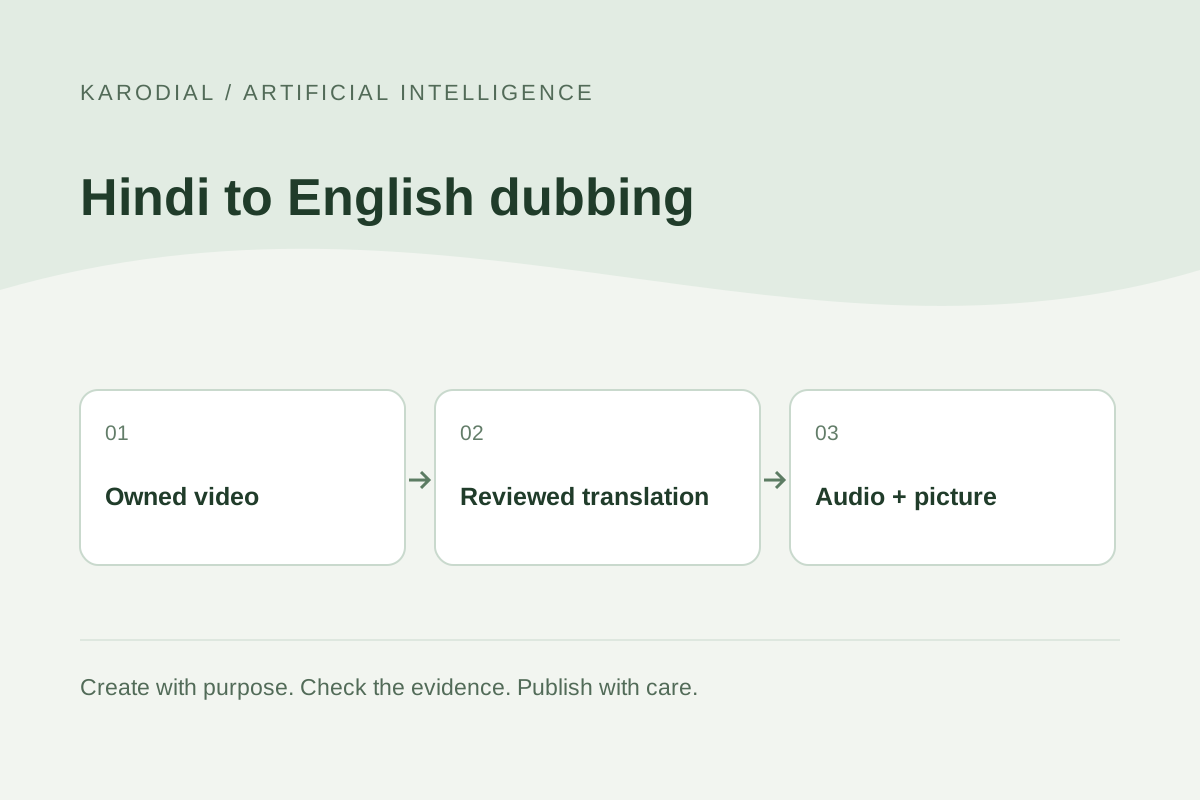
An English dub can make an original Hindi video accessible to another audience, but changing the spoken language is only one part of localization. The translation must preserve meaning, the voice must communicate naturally and important visuals must remain understandable. A fictional business publishing a service explainer on a KARODIAL website needs a result that customers can trust. This guide follows that project from source preparation to final review. AI can accelerate several steps, while human decisions remain essential to facts, permission and the finished listening experience.
Define the audience and delivery
Choose the intended English audience before translating. A local business introducing its services to international customers may need simple explanations for unfamiliar locations or terms. Do not assume every Hindi phrase has a useful word-for-word English equivalent. Record the message, required action and details that must remain unchanged, such as service scope and appointment instructions.
Decide whether the output is a full video, an additional audio track or a separate website version. Prepare captions as well as speech where appropriate. An English narration does not automatically translate text displayed inside the video. List titles, diagrams and contact information that also need review.
Confirm rights to the source material
Use a video you own or are authorized to adapt. Permission to view a public video is not necessarily permission to dub, redistribute or commercially use it. Check the script, footage, music and speakers separately. If voices will be preserved or synthesized, ensure the selected workflow and authorizations permit that use.
Keep a record of who approved the translated version and where it may appear. Do not assume a platform upload feature supplies missing rights. A customer testimonial or interview can need a different approval discussion from a narrator's original script. Make that decision before sending the source to an external processor.
Prepare the cleanest useful source
Start from the original master when available. Clear speech helps transcription and speaker handling. Avoid using a heavily compressed social-media copy if a cleaner file exists. Note sections with music, overlapping speakers or background noise because these deserve closer review. Keep an untouched original so mistakes can be traced and corrected.
Create a scene list with approximate timing and speaker names or neutral identifiers. Remove private or unnecessary sections before upload. Review the provider's current supported formats, limits, data controls and account requirements. Do not publish fixed limits in your workflow documentation without a review date because provider capabilities and plan restrictions can change.
Correct the Hindi transcript first
Read the source transcript while listening to the Hindi audio. Fix names, negations, amounts, dates and technical vocabulary. A transcription error can become a fluent but incorrect English line. Pay attention to missing short words that reverse a statement. Do not treat automatic punctuation as a reliable guide to the speaker's intended emphasis.
Mark unclear sections for the speaker or a fluent reviewer. Guessing can create a new business claim. For the fictional service video, the reviewer confirms that a maintenance offer excludes replacement parts. That distinction must survive the translation. A well-reviewed source transcript makes the next step more dependable and reduces repeated dubbing work.
Translate for meaning and spoken clarity
Write English that sounds natural when heard. Keep the offer, limitations and intended action accurate, even when sentence structure changes. Split long sentences where necessary. Adapt examples only when that helps the target audience and preserves the claim. Do not silently convert a local reference into a broader service promise.
Maintain a glossary for business names, product terms and preferred translations. Have a fluent reviewer compare the English with the Hindi source. Check whether an idiom needs explanation rather than literal replacement. Avoid adding superlatives, guarantees or endorsements that were absent from the original. Translation should improve access without inventing a more impressive business.
Generate and inspect the dubbed audio
Select a supported voice workflow and test a short representative segment. Current ElevenLabs documentation lists Hindi and English among its dubbing languages, but feature availability and editing controls depend on the product and plan. Confirm the exact workflow rather than assuming a dashboard feature is also available through every API.
Listen for names, numbers, stress and awkward pauses. Compare several sections, including the fastest speech and any emotional passage. A preserved voice identity does not guarantee correct pronunciation or delivery. Regenerate a specific problem where the tool supports controlled revision. If the translation is wrong, correct the text before spending time polishing its sound.
Review timing and the picture together
Play the dub against the original visuals. The English may need more or less time than the Hindi. Avoid squeezing too much speech into a short scene or leaving confusing gaps. If the speaker is visibly on camera, distinguish ordinary dubbing from any separately supported lip-sync workflow. Do not promise precise lip matching unless it has actually been checked.
Confirm that demonstrations, pointing gestures and on-screen labels still match the words being spoken. When a line says select the second option, the visible interface must show the correct choice. Review the final mix so music does not cover important speech. A technically complete audio file can still fail as a complete video.
Build a final master and captions
Use the approved audio in the original editing project where possible. ElevenLabs currently describes its dubbed video output as a preview rather than a production master, so its documentation recommends using downloaded dubbed audio with the original video for final production. Evaluate the chosen service's equivalent guidance before assuming that its preview preserves source quality.
Check resolution, frame rate, aspect ratio and the complete audio mix during export. Prepare English captions from the approved dub, then correct timing and line breaks. Captions should represent what the listener actually hears. Provide readable text for important contact details, and test the exported file on a phone before delivery.
Publish and maintain both languages
For the fictional KARODIAL project, the business reviews the Hindi transcript, approves the English script and checks the final master. The website labels each language clearly and offers the corresponding version without confusing navigation. This is a publishing example, not a claim that KARODIAL itself provides a built-in dubbing engine.
Keep source files, approved translations, rights records and final exports organized. When a service changes, update both language versions instead of leaving the English dub behind. Measure practical usefulness through customer questions and review feedback. A successful dub gives another audience the same dependable information, with natural speech and careful presentation, rather than simply replacing Hindi sounds with English sounds.