An AI music tool can produce an appealing track quickly, but a finished audio file does not answer every rights question. The lyrics, composition, performance, recording and uploaded references can involve different permissions. A provider may permit a particular use without guaranteeing copyright protection or approval from a distributor. For a creator preparing music for a video or business website, the useful approach is a documented review before release. This guide explains that review without treating one country's law or one provider's terms as a universal answer.
Identify the parts of the project
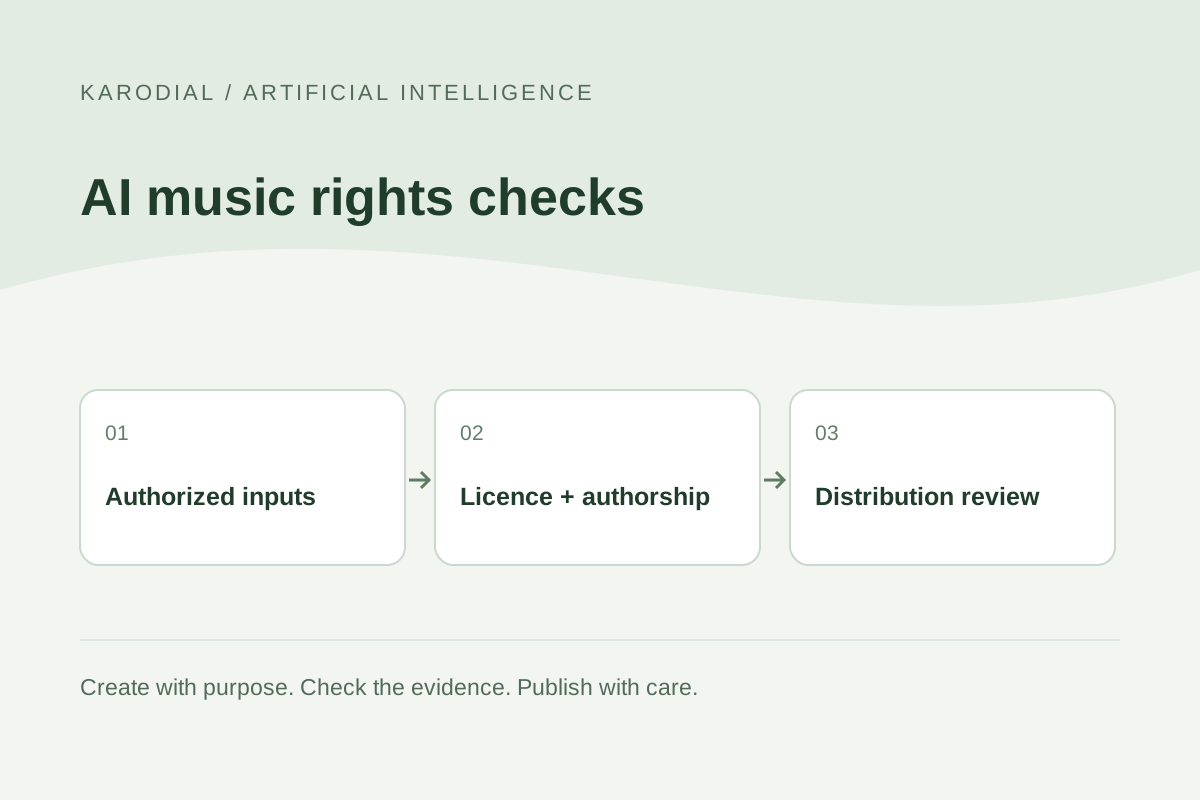
Start with a rights map. List the lyrics, melody, arrangement, recorded audio, vocals, samples and artwork. Record which parts you created, which came from a tool and which were supplied by another person. A song and a particular sound recording are distinct concepts in copyright practice; the U.S. Copyright Office explains that distinction in its music guidance.
Do not assume controlling one layer automatically clears the others. Owning a recording of yourself performing a song does not by itself establish permission to commercially use somebody else's composition. The same practical separation helps when an AI workflow combines original lyrics with generated audio or an uploaded reference.
Review the provider's current contract
Read the terms for the actual service, feature and account tier used. Save the relevant version and date. Distinguish permission to generate, download, edit and commercially distribute. These can be separate contractual questions. A pricing page or an old tutorial may omit conditions that appear in the current governing terms.
Suno's terms effective in September 2026, for example, describe commercial use in connection with permitted Downloads through approved channels and applicable allocations. They retain specific restrictions for Remixes. Avoid reducing that contract to the claim that every paid generation has unrestricted commercial rights. Check your exact track and workflow rather than relying on a broad slogan.
Separate licence from copyrightability
A provider's commercial permission is not a government determination that copyright exists in every output. In its 2025 report, the U.S. Copyright Office emphasizes human expressive authorship and says merely supplying prompts does not establish that authorship. Human-created expression, creative modification or arrangement may be relevant, assessed through the actual work.
That is U.S. guidance, not an automatic answer for India or every other jurisdiction. Applicable law and the facts of a project can differ. Keep evidence of your original lyrics, composition choices, recordings and editing. Do not promise exclusive copyright or effortless registration merely because the track was generated under a subscription.
Check references and borrowed material
An audio reference can contain protected lyrics, melody, performance and recording. Upload only material you are entitled to use for that purpose. A reference being available online does not establish permission to adapt it or submit it to an AI processor. Describe the intended reference role before starting: mood, instrumentation or your own authorized musical material.
Avoid treating a recognizable imitation as an original composition simply because the file was generated. If the result reproduces identifiable lyrics or music, pause and review. Changing the singer or instruments does not necessarily clear borrowed expression. Keep the reference, permission and output relationship documented so a later reviewer can understand what happened.
Handle voices and collaborators deliberately
Do not clone or imitate another person's voice or identity without the necessary permission and a workflow that allows it. Provider policies can impose stricter limits than a general agreement between collaborators. Make sure any vocalist, lyricist or musician understands the intended use, editing and distribution. Written project agreements are more dependable than assumptions made during an informal session.
Decide credits and responsibilities before release. Who supplies the lyrics, who approves the recording and who handles a rights complaint? If several people contributed, record their agreed roles accurately. Do not list a famous artist to suggest endorsement or invent a human performer for a synthetic part. Clear credits help listeners and reduce avoidable disputes.
Evaluate the music as a finished work
Listen to the full track rather than only its strongest section. Check intelligible lyrics, unwanted phrases, abrupt endings and changes in voice identity. Compare repeated hooks with the project's intended melody and references. A polished sound is not proof of originality, but careful listening can reveal material that needs further investigation.
Prepare a clean master and accurate metadata. Keep the approved lyrics and version alongside the audio. If the track supports a business video, ensure its mood and claims suit the project. Do not spend time distributing a technically impressive file before deciding whether it communicates the intended idea and whether its inputs and outputs have been reviewed.
Review distributor and store requirements
The distributor is another decision layer. DistroKid currently says it accepts AI-tool music subject to rights, no unauthorized impersonation, no infringement and no mass-generated spam. It also notes that streaming services can reject or remove content that fails their guidelines. Acceptance by a generator is therefore not a distribution guarantee.
Read the intended distributor's current declarations and answer accurately. Check metadata, artist identity, content labels and any service-specific restrictions. Avoid flooding a catalogue with near-duplicate tracks to manipulate discovery. Do not claim that a release is eligible for every store, exclusive rights service or revenue program unless the relevant current requirements have actually been met.
Match permission to the intended channel
Music for a website, a client advertisement, an album and a video platform may involve different permissions and contractual checks. Review the actual use instead of treating a generic commercial label as the end of the process. Consider the visuals and any third-party performance or brand reference included in the final project as well.
For a fictional KARODIAL website project, a studio wants an original instrumental under a service video. The team records the tool, account terms, permitted export and absence of borrowed audio. It checks the video use before delivery and keeps an alternative licensed track available. This is a practical publishing example, not a blanket legal clearance.
Keep a release record and resolve uncertainty
Build a compact release folder containing source lyrics, authorized references, generation identifiers, relevant terms, collaborator approvals and final exports. Note the target platforms and review date. These records do not eliminate legal uncertainty, but they help identify what was actually created and permitted. If a material rights question remains, obtain appropriate professional review before committing to the disputed use.
Recheck terms when starting a new project and respond to complaints through the appropriate process. Do not assume an old permission automatically covers a new feature or distribution arrangement. Responsible AI-assisted music publication joins creative judgment with transparent records. The goal is a useful, enjoyable work whose creator can explain its inputs, human contribution and release decisions.