An unfamiliar route, a new question or a conversation with someone outside your usual circle can make the world feel larger. Number 5 in numerology is often discussed through curiosity, movement and variety. The interesting part is not simply wanting change. It is deciding which changes deepen experience and which merely interrupt something worth continuing. Freedom becomes more meaningful when a person can choose deliberately rather than respond to every new possibility.
This detailed guide covers number 5 as a birth number and as a complete-date destiny number. It explains calculations, the traditional Mercury association, communication, study, relationships, work and original practical examples. Numerology is a symbolic cultural framework, not a proven measure of personality or a reliable forecast. The interpretations below are optional prompts, and the fictional situations illustrate questions rather than predict the lives of people with particular birthdays.
1. Use one clear date-based method
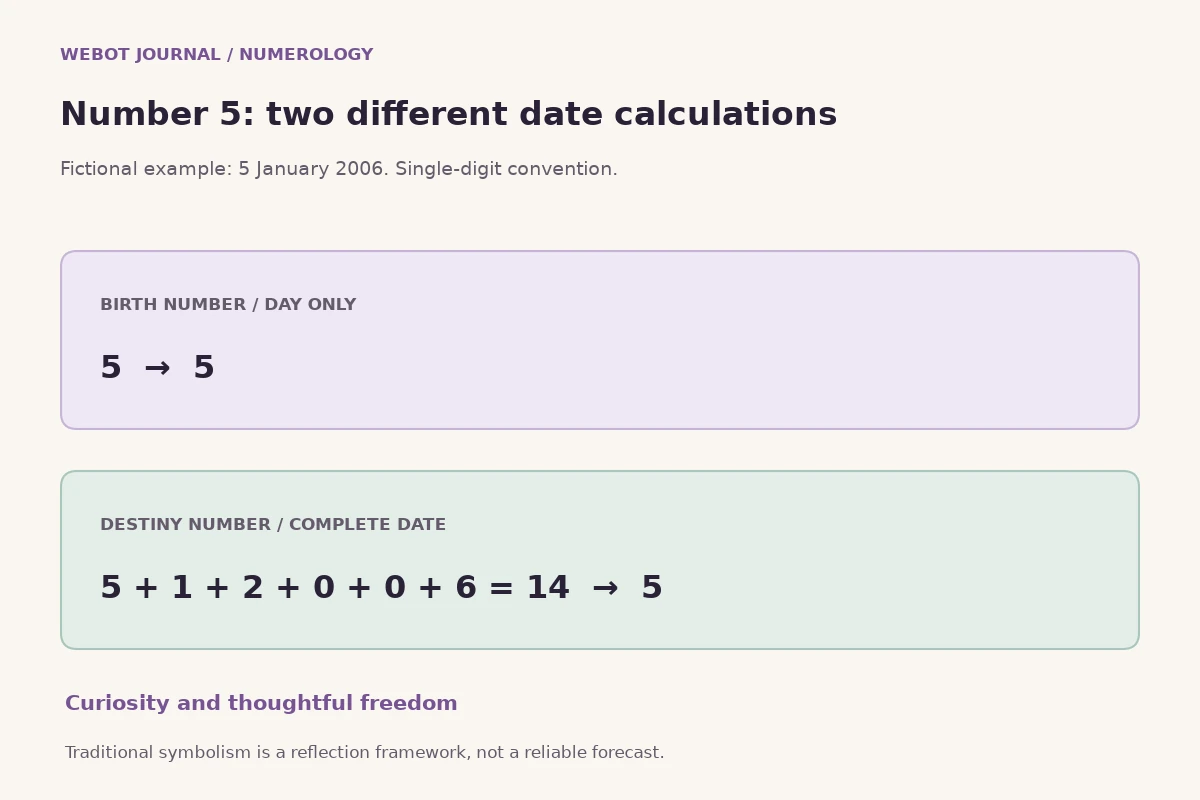
The birth number or Mulank comes from the day of birth alone. The destiny number or Bhagyank in this series comes from adding every digit of the full date and reducing the total to a single digit. These are different calculations with different inputs. A person can have either result without having the other, and no result is a score of personal worth.
The vocabulary is not universal. Other numerology traditions may use destiny for a name-based number or preserve certain master totals. This article uses the reduced date convention consistently so readers can compare numbers 1 through 9. It does not calculate names, infer a birth time or provide a horoscope. Make the convention explicit before interpreting a result or comparing it with a calculator that may follow different rules.
2. Birth number 5: the 5th, 14th and 23rd
The day 5 already has one digit. Fourteen becomes 1 plus 4, and twenty-three becomes 2 plus 3. Those are the three possible days of a month that reduce to 5. The month and year do not affect this birth-number calculation. Writing out the addition is useful because it makes the method accessible without requiring any specialist vocabulary.
Retain the original day in your notes. A person born on the 14th and someone born on the 23rd share the final reduced digit within this framework, but they do not therefore share a biography or a set of abilities. Compound-number readings may add another layer in some schools. This guide explains the common reduced category without treating it as a complete account of the individuals placed in it.
3. Worked examples for destiny number 5
For the fictional date 5 January 2006, add 5 plus 1 plus 2 plus 0 plus 0 plus 6. The total is 14, and 1 plus 4 gives 5. This example therefore has both birth and destiny number 5. Keep the intermediate total visible so another person can check the steps and identify an arithmetic error if one has been made.
Now take 14 June 1990. Its day reduces to 5, but the complete date totals 1 plus 4 plus 6 plus 1 plus 9 plus 9 plus 0, or 30. Thirty reduces to 3. The example is birth 5 with destiny 3. That difference is expected because the calculations use different information. Neither result establishes how the person will communicate, travel, work or build a relationship.
4. Mercury and the traditional image of exchange
The Indian numerology account used as a cultural reference associates number 5 with Mercury and emphasises communication, adaptability, resourcefulness and variety. These are interpretive correspondences rather than an established mechanism connecting a planet to an individual's character. They are useful to identify as tradition, without turning the language of planetary rulership into a scientific explanation.
Exchange offers an original way to explore the image. A useful exchange requires more than sending something quickly: information must arrive in a form the other person can understand. Someone reflecting through 5 can ask whether their flexibility makes communication clearer or whether constant changes make it harder to follow. The question directs attention to actual interactions rather than assuming that being quick with words always produces a good result.
5. Birth number 5 and the immediate interest in a new possibility
As a birth-number prompt, 5 can highlight the moment attention moves toward something unfamiliar. Imagine attending a workshop on a subject outside your usual interests. You ask an unexpected question and discover a connection with a project you already understand. Curiosity has expanded the conversation, not merely supplied a distraction from it.
If you recognise that pattern, examine what happens after the first interesting moment. Do you record the connection, test it or explain it to someone else? Or does the experience disappear as soon as another subject arrives? A reflective reading can distinguish curiosity that leaves a useful trace from novelty that passes without engagement. It does not need to label either response as a permanent characteristic assigned at birth.
6. Destiny number 5 and choosing a direction within variety
A destiny-number interpretation can use 5 as a continuing question about freedom and change. The theme need not mean frequent travel or abandoning every commitment. A person can have a stable home and still explore ideas, methods and forms of expression. Variety concerns the quality of engagement as much as the number of places visited.
A useful long-term question is what remains consistent while circumstances change. Perhaps you keep returning to a subject, a community or a kind of problem even as the setting varies. Naming that continuity makes freedom less shapeless. The reading offers a lens for examining choices, but it does not establish a destiny that makes settled commitments impossible or requires a particular lifestyle.
7. When both calculations reduce to 5
Matching birth and destiny values may be described as repetition of a theme. For 5, consider the relationship between immediate curiosity and the continuing choices that give curiosity a direction. Repetition does not mean permanent restlessness, inability to commit or exceptional luck. Strong claims of that kind cannot be established from the sum of a date.
Choose three recent new interests and compare them. Which became a useful skill, which remained enjoyable as a brief experience and which interrupted something more important? The answers may differ without one category being wrong. A thoughtful reflection recognises that some interests deserve depth and others deserve only a short visit. The aim is more deliberate choice, not proving that every change expresses the number.
8. Birth 5 with another destiny number
A birth-5 reading can be considered alongside another complete-date value without treating the pair as a conflict. With destiny 4, the question could be how experimentation becomes a repeatable method. With destiny 6, it could concern how personal freedom fits shared responsibilities. With destiny 3, it could explore the relationship between discovering an idea and expressing it clearly.
The fictional 14 June 1990 example gives birth 5 and destiny 3. Imagine a learner who enjoys trying unfamiliar tools and then prepares a short explanation for others. The useful task is to understand the tool well enough to explain its limits, not merely its exciting features. This is an original illustration of complementary questions, not a prediction that the date creates a particular occupation or talent.
9. Curiosity becomes stronger when the question is specific
A broad wish to know everything can lead to collecting fragments without understanding how they fit. A specific question gives exploration a purpose. Instead of asking what a subject is about in general, identify one thing you want to explain or compare. The smaller question can open a deeper investigation rather than narrowing curiosity unnecessarily.
For example, someone interested in photography might compare how one scene changes under two kinds of light. That experiment teaches more than browsing a long list of equipment without using any of it. A number-5 reflection can focus on this movement from attraction to inquiry. Curiosity is then judged by the attention it produces, not by the quantity of new material encountered in a short time.
10. Freedom includes deciding what to decline
Having many options can feel like freedom while making decisions harder. Each new invitation competes with plans already made, and declining anything may feel like losing an experience forever. Yet choosing a direction necessarily means leaving some possibilities unexplored, at least for now. That limit does not make the choice less free.
An original exercise is to name what you are choosing and what you are choosing not to do during the same period. A weekend devoted to finishing a piece of work may mean postponing an outing; an outing may mean accepting a smaller finish line for the work. Naming both sides makes the trade-off visible. The decision belongs to the person and their circumstances, not to a numerology rule that always favours movement.
11. Communication is more than speed and persuasion
A quick response can be useful, especially when a conversation needs momentum. It can also bypass an important qualification or make a possibility sound like a promise. Persuasive language should remain accurate about what is known, what is proposed and what has actually been agreed. Fluency is a tool whose usefulness depends on how it is used.
Try reviewing a message before sending it and separating those three categories. If a date is tentative, say so. If a feature has not been tested, do not describe it as dependable. Someone interested in the Mercury symbolism of exchange can use this as a practical standard. The goal is a message the recipient can act on correctly, not simply a message that sounds engaging.
12. Experimentation needs a question and an observation
Trying something new does not automatically make it an informative experiment. Without a question, the result may be difficult to interpret. A person may change several parts of a process at once, enjoy the novelty and conclude that the new version is better without knowing which change mattered. Clear observations make exploration more useful.
Imagine testing a different way to organise a study session. Decide whether you are trying to improve recall, reduce interruptions or make discussion more balanced. Change one manageable part and note what happened. The outcome may suggest keeping, revising or abandoning the idea. This is an original application of adaptability; it does not imply that a date gives someone superior experimental judgment.
13. Depth does not require abandoning breadth
A person with several interests may worry that choosing one area for deeper work will make life narrow. Yet depth can improve the connections between interests. Understanding one method carefully may reveal where an analogy with another subject works and where it breaks down. Breadth becomes more informative when at least some of its foundations are secure.
Choose a modest depth project rather than a permanent identity. You might spend a month learning enough about one topic to explain a specific problem clearly. Keep other interests in a list for later attention. Someone reflecting through 5 can use this approach to explore continuity without giving up curiosity. It is not a demand to become a different kind of person; it is a way to make one interest more substantial.
14. Work: adaptability must be demonstrated in context
Traditional profiles may connect 5 with communication or exchange, but that does not establish suitability for commerce, technology, media or any other profession. Work choices require actual information about skills, qualifications, preferences and opportunities. A numerology reading cannot assess those requirements or justify choosing someone for a role based on their date.
A more useful question is how you handled a real change. Did you ask what remained essential, learn a new process or help someone understand the transition? Describe the action and the result. This makes adaptability something concrete rather than an attractive label. You can then decide which skills to develop, using the work itself as evidence instead of assuming the number has already identified your strengths.
15. Study: alternate examples without losing the central concept
Varied examples can make a difficult subject easier to understand. The danger is moving to a fresh example before grasping what the first one demonstrates. A learner may recognise many illustrations while remaining unable to explain the underlying rule. Variety should help reveal the concept rather than continually postpone it.
After examining two examples, write the feature they share and one important difference. Then try a third example without copying the earlier steps mechanically. This gives a curious learner a clear task and a way to check understanding. It does not predict study ability from number 5. The exercise is available to anyone who wants to connect varied material through a coherent explanation.
16. Travel as attention rather than a numerical instruction
Number-5 descriptions often evoke movement, but travelling widely is not a requirement for a meaningful life. Resources, responsibilities, access and personal preference shape what travel is possible or desirable. A person can be curious within a familiar place, and another can visit many places without paying close attention to any of them.
As an original reflective exercise, explore a nearby public place with one clear question about its history, design or everyday use. Observe respectfully and record what surprised you. The activity illustrates curiosity without claiming that a number makes travel safe, necessary or lucky. Actual travel decisions should follow practical information and the needs of the people involved, not a symbolic expectation that you must always be on the move.
17. Relationships: freedom and clarity belong together
Wanting personal space or variety does not remove the need for clear agreements. Other people cannot respond fairly to expectations they have never heard. Equally, a shared commitment does not require giving up every individual interest. The useful conversation identifies what is shared, what is personal and how changes will be communicated.
Imagine one person deciding spontaneously to alter a weekend plan that involved others. The issue is not whether spontaneity is good or bad by nature. It is whether those affected received a real opportunity to discuss the change. A number-5 reading can prompt attention to that distinction. It should not become an excuse that a person is too freedom-loving to keep ordinary promises or consider someone else's time.
18. Compatibility prompts for all nine numbers
With 1, discuss who initiates a change; with 2, how its effects are heard; with 3, how possibilities are communicated accurately; with 4, how a trial becomes a dependable arrangement; with 5, how two people maintain continuity; with 6, how exploration fits care; with 7, how experiences are examined; with 8, how responsibilities survive change; and with 9, what purpose the exploration serves.
These are original discussion themes rather than a list of approved partners. A shared or different number does not establish trust, affection or practical compatibility. Ask about expectations directly and observe behaviour over time. Do not use a chart to override consent, excuse broken agreements or decide that someone is unsuitable for friendship, marriage, education or work simply because of a reduced date.
19. Family life can include planned flexibility
A household may contain people who enjoy spontaneity and people who need advance notice. Treating one preference as inherently superior can create unnecessary conflict. A workable arrangement may protect a few essential commitments while leaving other periods open. Flexibility becomes easier when everyone understands which parts of the plan are stable.
For example, a family outing might have an agreed departure time and an open choice of afternoon activity. That division can preserve both coordination and discovery. Someone reflecting through 5 can ask whether they communicate their wish for flexibility before others make arrangements. The discussion concerns practical consideration, not a claim that a number entitles one person to change shared plans whenever a new idea appears.
20. Children need exploration and appropriate continuity
A child who enjoys novelty may benefit from opportunities to try different activities, but numerology cannot determine what the child needs. A date-based label should not turn changing interests into a permanent fault or be used to assume the child cannot finish anything. Adults should attend to the actual setting, task and child's response.
Offer choices that are manageable and allow enough time to understand an activity before replacing it. Ask what the child enjoyed and what was difficult. The answers may reveal a preference more accurately than a broad description of restlessness. If a family enjoys number symbolism, keep it optional and imaginative. Educational expectations and opportunities should be based on the child's demonstrated needs and interests rather than numerical membership.
21. Traditional Wednesday, green and emerald associations
The Indian reference account associates 5 with Wednesday, green and emerald. These are traditional correspondences linked with Mercury in that framework. They do not establish that choosing a colour or wearing a gemstone changes events. There is no requirement to purchase anything or select important dates according to this article.
A reader might use green as a visual theme for a journal page about curiosity, just as an artist chooses a palette for a subject. The symbolic meaning can be personally enjoyable without becoming a claim of protection or advantage. This guide does not prescribe gemstone use or promise a result from it. Keep cultural description, personal preference and factual assessment of an actual decision in their proper places.
22. An exploration journal with a useful finish line
Choose one new experience and write three short notes afterwards: what you expected, what you observed and what you would investigate next. Keep observation separate from interpretation. If a conversation changed your view, identify the particular information that mattered rather than describing the whole encounter as a sign that everything must change.
Then decide whether the experience deserves a follow-up or can remain a complete brief encounter. Both answers are acceptable. This exercise gives variety a record and a point of choice. It can reveal a recurring interest without requiring you to pursue every possibility. Its usefulness comes from the attention and reflection involved, not from a claim that number 5 has directed events.
23. Common questions about number 5
Are the 5th, 14th and 23rd the only birthday dates in this category? Yes, under the single-digit day method. Can someone with another birthday have destiny number 5? Yes, because that calculation uses the entire date. Does the Mercury association make someone naturally persuasive? No, communication skills must be understood through actual practice and context.
Does 5 mean a person cannot sustain a relationship or a routine? No. Is travel necessary to fulfil the number? No. Are Wednesday and green mandatory choices? They are cultural associations, not instructions. Does a new opportunity become suitable because the number supposedly favours change? No; assess the opportunity using relevant information about what it actually involves.
24. Choose freedom with attention
Number 5 can be an engaging image for curiosity, exchange and the possibility of change. Its most useful questions concern attention: what are you discovering, what are you leaving unfinished and what matters enough to continue? Those questions make room for both movement and commitment. They do not require turning either into a permanent identity.
Keep your checked arithmetic separate from the traditional association and from the meaning you choose to give it. Accept what helps describe experience and leave aside what does not. A thoughtful reading may encourage a clearer message, a better experiment or a more deliberate choice. It does not need to predict the future or make every unfamiliar path more valuable than the one you are already following.
Sources and further reading
- Sanatan Society: number 5 in Indian numerology
- Numerology.com: different conventions for date and name-based core numbers
- Inner Traditions: Harish Johari numerology publication
Originally published by WeBot. Republished on KARODIAL on 29 October 2026. View original article