Number 1 is often the first number people meet in numerology, yet its interpretation is more interesting than a label such as born leader. It can represent the moment an idea becomes a decision: someone makes the first sketch, asks the first question or accepts responsibility for starting. The same image can also raise a difficult question. How does a person act independently while remaining open to other people? That tension gives the number a useful theme for reflection.
This guide covers number 1 as both birth number and destiny number using a clearly stated date-based Indian numerology convention. It explains the calculations, traditional associations, everyday examples and the limits of the reading. Interpretations are cultural beliefs, not a diagnosis of personality or a reliable forecast. A date does not determine a person's ability, relationships or future. Use the ideas as prompts you may accept, adapt or leave aside rather than as instructions that must govern your life.
1. Know which calculation the reading uses
Here, birth number means the day of birth reduced to a single digit. It is also called Mulank or, in some Indian numerology writing, psychic number. Destiny number means the complete date of birth reduced to a single digit and is often called Bhagyank in this context. State this convention whenever you compare a reading with another source. Otherwise, two different calculations can appear to contradict each other even when both have been performed correctly.
Terminology varies. Some Western numerology sources use destiny or expression number for a value calculated from a name, and use life path for the full date. Some retain master numbers at particular stages; some describe a birthday number without reducing the day. Those are different conventions. This article uses the single-digit date method for a consistent discussion of 1 through 9. It does not calculate a name number or claim that every school uses these words identically.
2. Calculate birth number 1 step by step
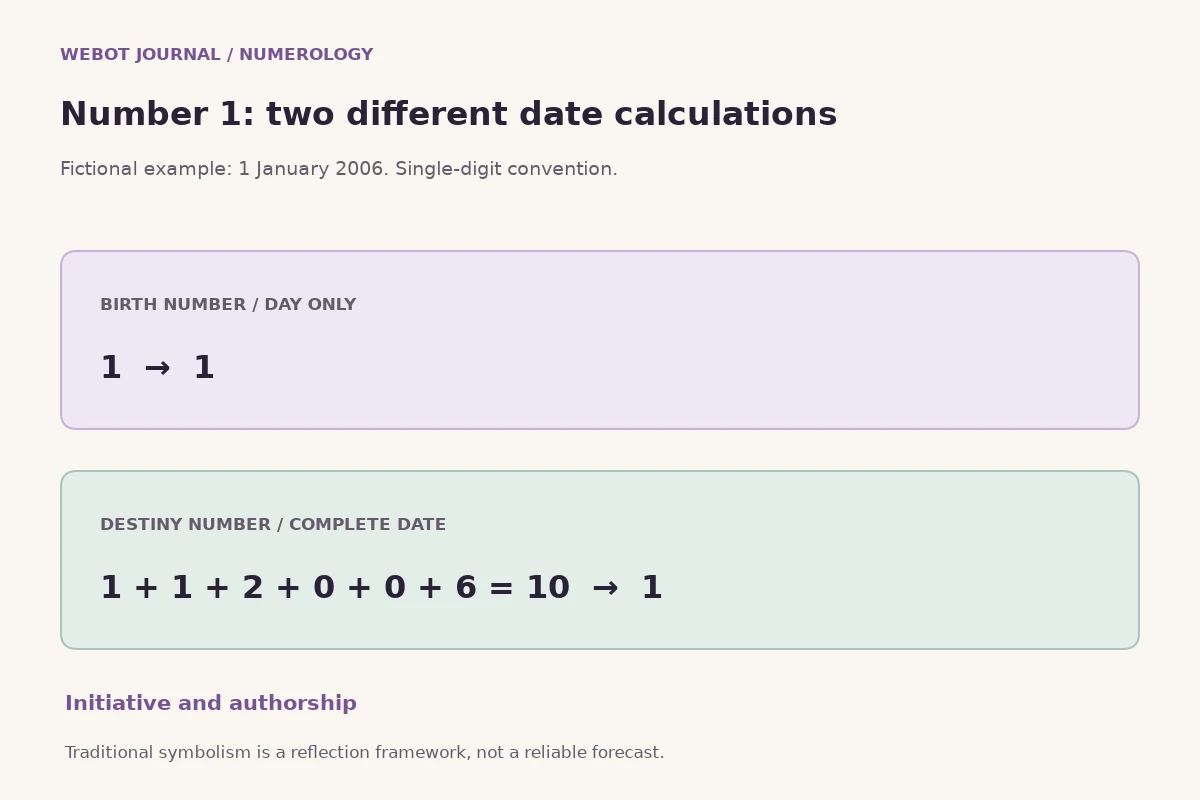
Under this method, people born on the 1st, 10th, 19th or 28th of a month have birth number 1. The arithmetic is straightforward: 10 becomes 1 plus 0; 19 becomes 1 plus 9, then 1 plus 0; 28 becomes 2 plus 8, then 1 plus 0. The month and year are not used for this particular calculation. The result identifies a category within the chosen tradition, not an achievement or a score.
Write the original day beside the reduced result. Someone born on the 1st and someone born on the 28th share the reduced value while retaining different dates. Some practitioners attach additional meanings to compound numbers, but a shared final digit does not require two people to have the same history. Keep the simple calculation separate from any extra interpretation. This prevents an arithmetic exercise from quietly turning into a claim that everyone in the group behaves alike.
3. Calculate destiny number 1 with a fictional date
For the date 1 January 2006, add the date's digits: 1 plus 1 plus 2 plus 0 plus 0 plus 6 equals 10. Reduce 10 to 1. In this example, both the birth number and the date-based destiny number are 1. The date is used only to demonstrate the method. It is not a prediction about anyone born then, and no personal information needs to be entered or stored to understand the calculation.
A different example shows why the two values should not be confused. For 28 July 1990, the birth number reduces to 1, while the complete date totals 36 and reduces to 9. The person would therefore read birth number 1 and destiny number 9 within this convention. Verify the arithmetic before discussing the symbolism. A mistaken sum cannot be repaired by a confident interpretation, and an interesting description is not evidence that the original calculation was correct.
4. The traditional symbolism of the Sun
In the Indian numerology account published by Sanatan Society, number 1 is associated with the Sun. The symbolism includes visibility, confidence, direction and a wish to lead. These are features of that interpretive framework. They do not mean that the Sun assigns a personality type to people born on certain dates. The astronomical Sun and its cultural use as an image should remain distinct.
Think of the image as a question about how someone occupies a space. Does visibility help the person communicate a useful purpose, or does being seen become the purpose itself? Can confidence make a difficult beginning easier for a group, or does it discourage anyone else from contributing? These questions are useful because they describe choices. They leave room for a person to respond differently instead of treating a symbolic association as a permanent verdict.
5. Birth number 1: the immediate impulse to begin
As a birth-number reading, the theme of 1 can be explored through the first response to a situation. Imagine a meeting where nobody volunteers to start. One person proposes a rough plan, knowing it will need improvement. The constructive feature is not that the proposal must be right. It is that an uncertain discussion now has something concrete to examine. Initiative creates a starting point others can work with.
If this description resonates, ask where your willingness to begin has been useful. Perhaps you organise a family task or start a conversation that others avoid. Also ask where beginning too quickly has created extra work. The same action can have different results depending on timing and preparation. Reading the symbol thoughtfully means examining those differences, rather than collecting flattering adjectives and assuming they apply in every setting.
6. Destiny number 1: a continuing question of authorship
In a destiny-number interpretation, 1 can be used as a recurring theme of authorship: deciding what you are willing to stand behind. That is broader than holding a leadership title. A person can show authorship by taking care over a small piece of work, expressing a considered view or following through on a commitment without being reminded. The emphasis is on responsibility for a contribution, not status over other people.
A useful reflective question is whether you are choosing an objective or merely reacting against someone else's objective. Independence can look energetic while remaining entirely defined by opposition. Writing down what you want to create, for whom and why makes the distinction clearer. Nothing in a numerology calculation proves that this is a predetermined life task. The reading offers a lens; the person remains free to judge whether the lens helps.
7. When birth and destiny are both 1
When both calculations reduce to 1, some readers describe the central theme as repeated. A practical way to understand that repetition is to explore initiative at two levels: the quick urge to act and the longer pattern of commitments. They may support each other, but they do not have to. Someone can enjoy starting new things while finding sustained ownership difficult. That observation deserves attention rather than an automatic assumption of exceptional leadership.
Use a recent project as an example. Who suggested it, who clarified its scope and who kept it moving after the excitement faded? If you performed the first role but not the others, the lesson may be about follow-through. If you performed all three, consider whether sharing responsibility would make the work stronger. A repeated number need not be treated as an amplified entitlement to control. It can instead make the reflection more specific.
8. Different birth and destiny numbers can describe different questions
A birth number of 1 paired with another destiny number does not require a battle between two fixed personalities. Within the framework, you can treat the birth reading as one prompt and the full-date reading as another. One might highlight how you begin; the other may encourage reflection on cooperation, expression, care or another theme. The value lies in asking a richer question, not in assigning a winner between the numbers.
Return to the fictional birth-1, destiny-9 example. A person might use initiative to begin a community project while using the second theme to examine whom the project serves. That is an invented illustration, not a forecast from the date. It shows how the readings can be discussed together without claiming that a person must behave a certain way. Real preferences and circumstances provide the material for the discussion.
9. Confidence that leaves room for correction
Confidence is most useful when it makes a proposal clear enough to test. Consider the difference between saying that a plan cannot fail and explaining why you think it is worth trying. The second statement leaves room for questions, new information and a change of course. It also allows others to help without first having to defeat the person who proposed the idea.
For someone using number 1 as a reflective theme, a useful exercise is to add one uncertainty to every major proposal. State what you know, what you assume and what would make you reconsider. This does not weaken a contribution. It makes the basis of the contribution visible. The exercise is an original practical suggestion, not a ritual guaranteed to change luck. Judge it by whether it improves the actual conversation.
10. Initiative and impatience can look similar
An energetic beginning can be mistaken for effective progress. A person may send several messages, reorganise a task and announce a deadline before understanding what the work requires. The activity is visible, but its usefulness is uncertain. In the language of the number's symbolism, the challenge is to distinguish initiating a helpful action from acting mainly to escape the discomfort of waiting.
Try describing the smallest useful next step before taking the largest available action. For a new idea, that might mean writing a one-paragraph outline instead of committing the whole group. For a disagreement, it might mean asking one factual question before issuing a conclusion. The aim is not to become passive. It is to make initiative proportionate to the information available and the people affected by the decision.
11. Leadership without a title
A person does not need to manage others to practise dependable leadership. Clear handovers, honest updates and a willingness to acknowledge a mistake can make someone valuable in a group. These actions are often quieter than the image of a commanding personality. They also make the idea of leadership more inclusive: a reserved person may contribute direction through careful preparation rather than forceful speech.
If a number-1 reading encourages you to lead, define the behaviour you mean. Will you clarify an unclear request, support a newcomer or make a responsibility visible? A concrete definition is easier to practise than a claim that you are naturally above following instructions. Every shared activity involves both initiative and coordination. Treating either role as inferior makes cooperation harder and gives the symbol a meaning it does not need to carry.
12. Collaboration: make room for another first idea
Imagine two people who both enjoy proposing the opening plan. Their difficulty may not be a lack of ability; it may be that each proposal arrives before the other person has finished speaking. A useful agreement is to hear both versions before choosing parts of either. This turns a contest over whose idea appears first into a comparison of what each idea contributes.
Someone reflecting through number 1 can notice whether other people receive a real opportunity to initiate. Asking for suggestions after every major decision has already been made is different from inviting them while choices remain open. The distinction is observable in an ordinary meeting or household task. A number does not determine whether someone collaborates well; the person's actions in those moments provide better evidence.
13. Work and study: use initiative as a skill to practise
Traditional number profiles often suggest roles involving direction or administration. Such suggestions are associations, not a method for selecting a profession. Skills, interests, opportunities and the requirements of the work matter independently. A person who identifies with initiative might explore how it appears in study, creative work, organisation or a technical project without assuming that one symbolic category narrows their options.
For study, initiative could mean choosing a question to investigate and then accepting the discipline of checking the answer. For a creative project, it might mean making an initial version and inviting criticism. For a shared task, it could mean clarifying who needs what before distributing work. These examples describe transferable behaviours. They do not predict examination results, justify a career decision or establish that a person should be hired for a particular role.
14. Starting a business is not a number calculation
The image of independence can make business ownership sound like the obvious expression of 1. That conclusion skips many real questions. A business idea involves customers, practical capability, time and resources. The date calculation does not assess any of them. It can be a private reflection on initiative, but it should not be used as proof that an enterprise is suitable or that success is due.
A more useful symbolic exercise is to describe the problem you would like to solve before describing yourself as a founder. Who experiences the problem, and what would a helpful response look like? This keeps attention on the work rather than the identity attached to beginning it. Any actual business decision needs its own evidence and appropriate assessment. A numerology reading does not provide that assessment.
15. Relationships: independence with consideration
In a relationship discussion, the theme of 1 can raise questions about autonomy and shared decisions. Wanting time for a personal project is different from assuming that every household plan should adapt around it. Both people need the opportunity to describe what matters to them. A symbolic reading is most constructive when it begins that conversation rather than settling it on one person's behalf.
Try naming one decision that belongs to you and one decision that requires agreement. The boundary may be obvious for some matters and negotiable for others. Discuss the boundary directly. A birth number cannot establish whether someone is considerate, trustworthy or compatible. Those judgments should come from conduct and the relationship itself. Avoid using a reading to excuse controlling behaviour or to label another person's needs as an obstacle to your destiny.
16. Compatibility with numbers 1 through 9
Compatibility charts differ, sometimes even between friendly-number lists and lists for specific kinds of relationship within the same source. Rather than treating one chart as a selection rule, use the nine numbers as conversation themes. With 1, discuss sharing initiative; with 2, consultation; with 3, expression; with 4, structure; with 5, flexibility; with 6, care; with 7, space for inquiry; with 8, responsibility; and with 9, the wider purpose of a plan.
These prompts are an illustrative framework, not a test that establishes compatibility. Any pair of people can have different habits, circumstances and expectations regardless of their numbers. Ask about those directly. A chart should not be used to reject a partner, employee or collaborator, nor to ignore a serious concern because the numbers supposedly match. Agreement is something people create through the actual relationship, not something this page certifies from dates.
17. Family roles and the pressure to be the strong one
A person known for taking charge can become the default organiser for everything. Over time, the role may feel compulsory. A number-1 interpretation can unintentionally reinforce that pressure if it says the person must always be strong or decisive. A more helpful reading allows for limits, uncertainty and asking other people to take responsibility.
Consider a family event. One person may enjoy choosing the overall plan but dislike handling every small arrangement. Splitting the work can preserve their initiative while making participation more balanced. The example is ordinary, but that is its value. A symbolic theme becomes useful when it helps name a practical pattern. It becomes restrictive when it tells someone that asking for support would betray who they are supposed to be.
18. Children should have room to develop beyond a label
If a child has birth number 1, describe the tradition as a story about possible qualities rather than a fixed identity. A child who is told they must be a leader may feel embarrassed about enjoying a supporting role. Another may interpret the label as permission to dominate a group. Neither consequence is necessary for a family to enjoy learning about numbers.
Notice what the child actually enjoys and how they respond to other people. Offer opportunities to begin a small task, share a task and finish a task without ranking those experiences by numerology. Praise concrete actions, such as explaining an idea clearly or listening to a friend. A date-based reading cannot assess development, educational needs or personality, and should not replace observation or an appropriate professional evaluation when one is needed.
19. Lucky dates, Sunday and personal routines
The Sanatan Society profile associates 1 with Sunday and gold, alongside its Sun symbolism. Dates reducing to 1 are also commonly used when discussing this number. These are traditional correspondences, not evidence that a day or colour changes the outcome of an appointment. If someone enjoys choosing a notebook colour or a regular time for reflection, the choice can remain a preference without becoming a requirement.
Do not move an important commitment solely because an attractive date appears in a reading. Availability, preparation and the needs of other people remain relevant. A simple personal routine can be chosen because it is easy to maintain. Its usefulness can then be assessed through what it helps you do. This is different from promising that repeating the date or surrounding yourself with a colour will produce a particular result.
20. Gemstones, names and symbolic remedies
Ruby appears in the traditional correspondence list for 1 in the cited source. That is a statement about the source's belief system, not a recommendation to buy or wear a stone. Jewellery preferences, budget and any practical concerns should be considered separately. This guide does not claim that a gemstone treats a condition, guarantees prosperity or compensates for an unfavourable number combination.
Name-based readings belong to a separate calculation, with different letter-value conventions. Changing a spelling does not change the date used for the birth and destiny calculations in this article. Nor does this page provide a reason to alter legal documents or a professional identity. If you study a symbolic practice, keep its method and claims visible so that an optional interest does not become an unexplained obligation or an unnecessary purchase.
21. What the number cannot tell you
A number-1 reading cannot establish a person's health, future income, moral character or likelihood of success. It also cannot explain every setback as a failure to follow a symbolic rule. Those claims would require evidence the calculation does not provide. A difficult event should not be used as an opportunity to blame someone for having the wrong date, name or object.
This boundary leaves plenty of room for a thoughtful use of the tradition. You can read about a cultural framework, discuss which themes resonate and use a prompt to examine your choices. The important point is that the reflection remains open to revision. If a description does not fit, you do not need to force your experience into it. A useful reading should make your understanding more flexible, not less.
22. An original example: the first proposal and the second draft
Imagine a volunteer, Mira, who enjoys beginning community projects. She proposes a small reading group and quickly chooses a venue. When other volunteers raise access concerns, she initially hears criticism of her initiative. The group improves when she separates the value of starting from the need to be right. A second draft of the plan includes the concerns without erasing her contribution.
The story is fictional and not linked to a date of birth. It illustrates the central tension of this guide: initiative creates possibilities, while responsibility includes listening to what happens after the beginning. You can apply the same question to your own experience without assuming the number predicted it. Ask which part of a project you are proud to have started and which part became better because someone else helped change it.
23. A practical reflection exercise for number 1
Choose one manageable commitment that matters to you. Write the first action, the person it should help and the point at which you will review it. Add one way another person could improve the idea. This turns the broad theme of initiative into a specific experiment. You are not asking the number to guarantee the outcome; you are deciding how to examine an action you can actually take.
After the review point, record what happened without changing the original objective to make the result look better. Did you begin, did you follow through and did you accept useful feedback? The answers may suggest another step or a different priority. Keep the exercise modest. Reflection does not require exposing personal details online, buying a report or proving that every event corresponds to a digit.
24. Common questions about birth and destiny number 1
Are all people born on 1, 10, 19 or 28 alike? No. They share a result under the stated reduction method, not a complete personality. Does destiny number 1 mean leadership is guaranteed? No. Can someone have birth number 1 and another destiny number? Yes; the worked example above demonstrates that. Is a name-based destiny number the same calculation? Not in the convention used here, so compare definitions before comparing results.
The main themes are initiative, authorship and the responsibility that follows a beginning. Whether you find those themes helpful depends on your own experience. Keep the arithmetic accurate, the tradition clearly identified and the interpretation open to questions. That approach allows number 1 to become a thoughtful subject of cultural study and personal reflection without pretending that a date has already decided the life a person will lead.
Sources and further reading
- Sanatan Society: number 1 in Indian numerology
- Numerology.com: different conventions for date and name-based core numbers
- Inner Traditions: Harish Johari numerology publication
Originally published by WeBot. Republished on KARODIAL on 29 October 2026. View original article